Story Summary
Explore the history of Julius Caesar Crosses the Rubicon, the moment he defied the Senate and changed Rome forever. Discover the meaning behind the die is cast.
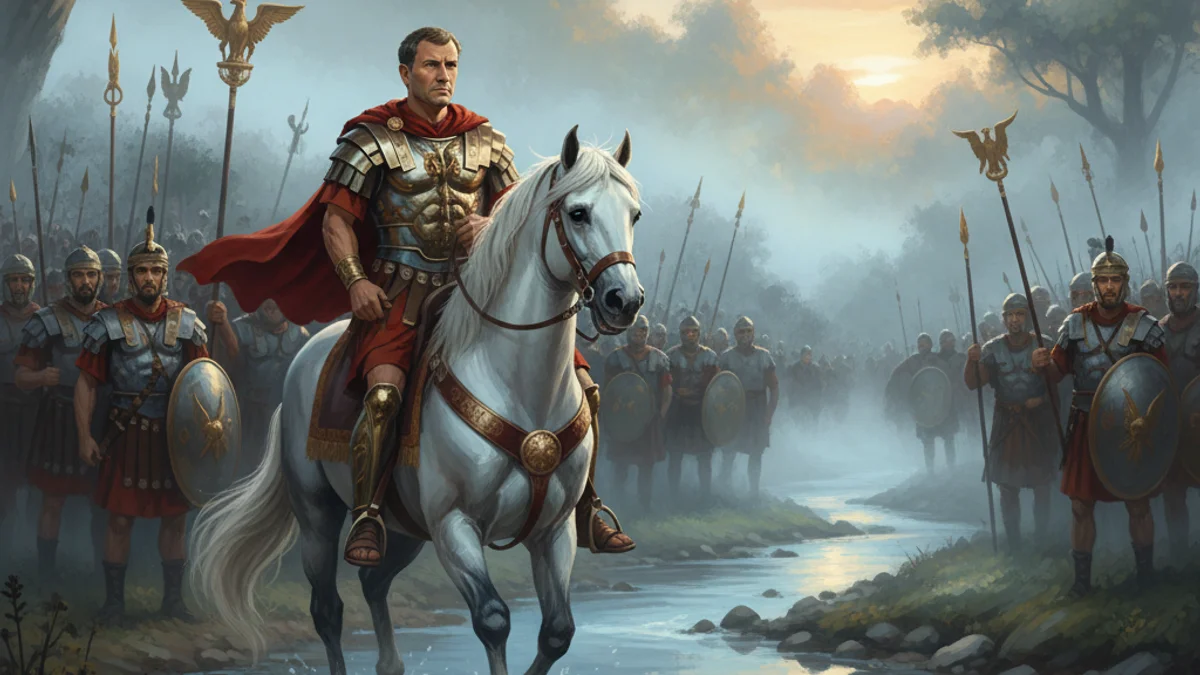
In 49 BC, Julius Caesar stood on the banks of the Rubicon, a shallow river separating Cisalpine Gaul from Italy. Under Roman law, bringing an army across this boundary was an act of high treason—a declaration of civil war against the Senate and his rival, Pompey. Caesar paused at the water's edge, weighing the immense cost of his ambition against the certainty of political destruction if he retreated. To move forward meant war; to stay meant ruin. Turning to his soldiers, he uttered the immortal words, 'Alea iacta est'—the die is cast. By leading his Thirteenth Legion across the stream, Caesar committed himself to a path from which there was no turning back, forever altering the fate of the Roman Republic and the course of history.
The Moral
True leadership requires the courage to accept the risks of an irreversible choice and face the consequences of one's ambition.
“Alea iacta est (The die is cast).”
Fun Fact
The exact location of the ancient Rubicon was lost to history for centuries until researchers in 1991 officially identified the Fiumicino river as the original boundary.
Frequently Asked Questions
What is the moral of Julius Caesar Crosses the Rubicon?
The moral is that significant progress often requires making an irreversible commitment. It teaches that once a major decision is made, one must move forward with total resolve.
Why was crossing the Rubicon considered a crime?
The Rubicon served as the border between Caesar's province and Italy; bringing an army across it was legally defined as an armed invasion of Rome. It signaled the start of a civil war.
What does the phrase 'the die is cast' mean?
It refers to the rolling of dice in a game of chance. It means that a decision has been made and there is no way to undo it or go back to the previous state.
Who was Julius Caesar fighting against?
He was primarily fighting against the Roman Senate and his former political ally, Pompey the Great, who represented the traditionalist faction of the Republic.
What was the result of Caesar's decision?
Caesar's crossing led to a four-year civil war from which he emerged victorious. This eventually resulted in him being named dictator for life and the end of the Roman Republic.
Which legion did Caesar lead across the river?
Caesar crossed the Rubicon with his most trusted and veteran unit, the Legio XIII Gemina (the Thirteenth Legion), which was known for its extreme loyalty to him.
Discussion (0)
Share your thoughts on this story
No comments yet. Be the first to share your thoughts!