
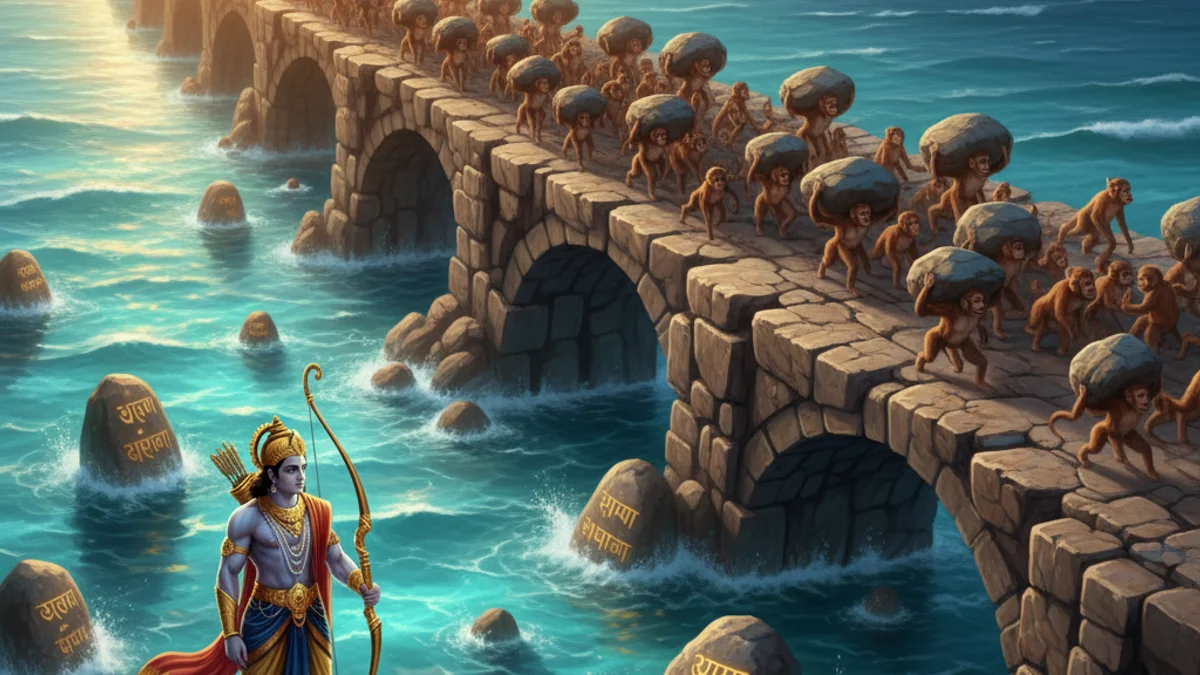
After the long search for Sita led the Vanara army to the southern shores of India, Lord Rama faced a daunting obstacle: the vast, churning ocean separating them from Lanka. Rama prayed to the Sea God for passage, but when the waters did not part, he prepared to loose a celestial arrow to dry the sea. The Sea God appeared, advising Rama that two Vanaras in his army, Nala and Nila, possessed a divine gift for architecture. Under their guidance, the massive army began collecting boulders and trees. Legend says that when the soldiers inscribed the name 'Rama' upon the stones, the heavy rocks defied gravity and floated upon the waves. As the bridge stretched toward the horizon, a tiny squirrel began rolling in the sand and shaking it into the crevices between the stones. When the Vanaras laughed at the creature, Rama gently rebuked them, explaining that the squirrel's devotion was as valuable as their strength. In just five days, the miraculous causeway—the Ram Setu—was completed, allowing Rama, Lakshmana, and the Vanara heroes to march toward Lanka to confront Ravana.
True success is achieved through collective effort, and even the smallest contribution is significant when offered with devotion.
Questions about this story
What is the moral of The Building of Rama's Bridge?
The story teaches that teamwork and devotion can overcome any obstacle. It also emphasizes that no contribution is too small, as shown by the squirrel assisting the great army.
Who were the architects of Rama's Bridge?
Nala and Nila, two brothers in the Vanara army, were the primary architects. They were said to be the sons of Vishwakarma, the divine architect of the gods.
Why did the stones float in the water?
According to the legend, the stones floated because the name of Lord Rama was inscribed upon them. This symbolizes the power of faith and the divine nature of the mission.
Is Rama's Bridge a real place?
Yes, it is often identified with Adam's Bridge, a chain of natural limestone shoals between Pamban Island off India and Mannar Island off Sri Lanka.
Advertisement
Good night.
