
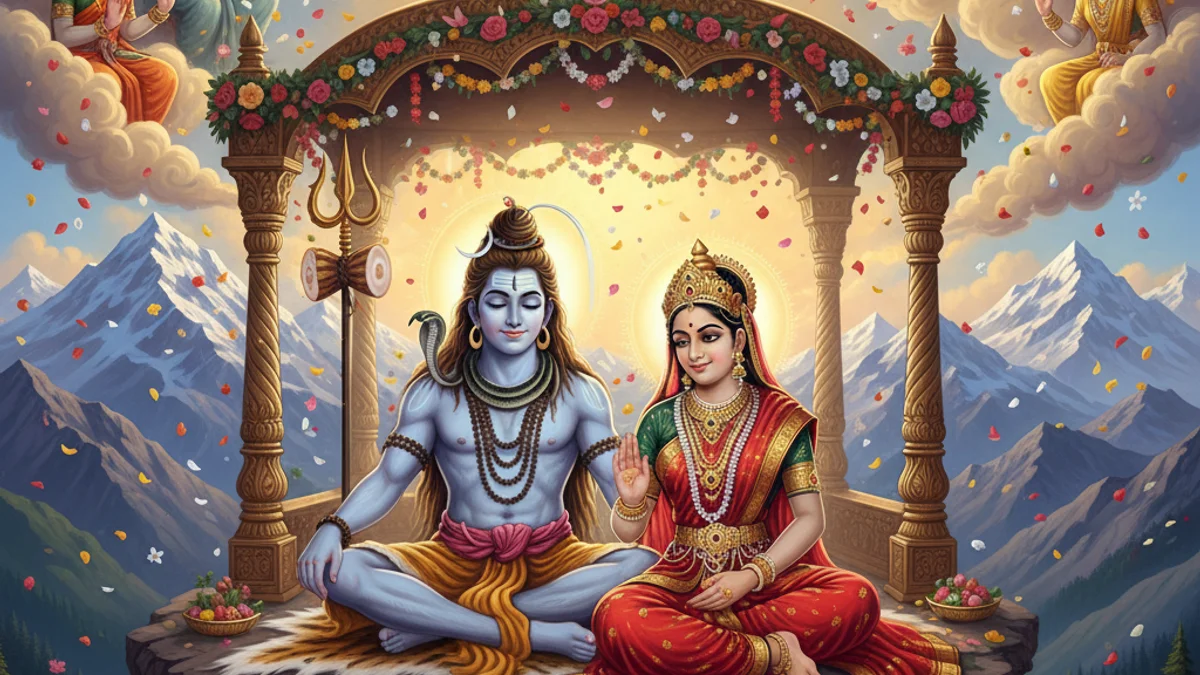
After the tragic loss of his first wife Sati, Lord Shiva retreated into the high Himalayas, entering a state of profound, eternal meditation as an ascetic. Sati was eventually reborn as Parvati, the daughter of King Himavan. From her youth, Parvati was drawn to Shiva, yet the great god remained indifferent to the world. Seeking to aid her, the god of love, Kamadeva, attempted to stir Shiva’s heart but was incinerated by the fire of Shiva's third eye. Realizing that beauty and desire would not win the ascetic, Parvati turned to 'Tapas'—intense spiritual penance. She abandoned her palace, living in the freezing wilderness and surviving on nothing but air to prove her devotion. Shiva, moved by her resolve, visited her disguised as a wandering Brahmin and mocked his own divine persona to test her. Parvati’s fierce defense of his true nature finally convinced Shiva of her pure love. The two were wed in a magnificent ceremony attended by gods, demons, and sages alike, marking the sacred union of Purusha and Prakriti, the cosmic forces of consciousness and energy.
True love and spiritual goals require unwavering perseverance, patience, and the strength to look beyond superficial appearances.
Questions about this story
What is the moral of Shiva and Parvati's Wedding?
The moral is that true devotion and spiritual resilience can overcome even the greatest obstacles. It teaches that deep connection is earned through sacrifice and internal strength rather than external beauty.
Why did Parvati have to perform penance?
Parvati performed penance (Tapas) to prove her devotion was spiritual and not just based on physical attraction. It was her way of matching Shiva's own ascetic intensity and showing she was his equal.
Who tried to help Parvati win Shiva's heart first?
Kamadeva, the god of desire, tried to strike Shiva with an arrow of love. However, Shiva was angered by the distraction from his meditation and burnt Kamadeva to ashes with his third eye.
How did Shiva test Parvati's devotion?
Shiva disguised himself as an old Brahmin and visited Parvati while she was meditating. He spoke ill of Shiva, calling him a beggar and a dweller of cremation grounds, to see if Parvati would be swayed by public opinion.
Advertisement
Good night.
