
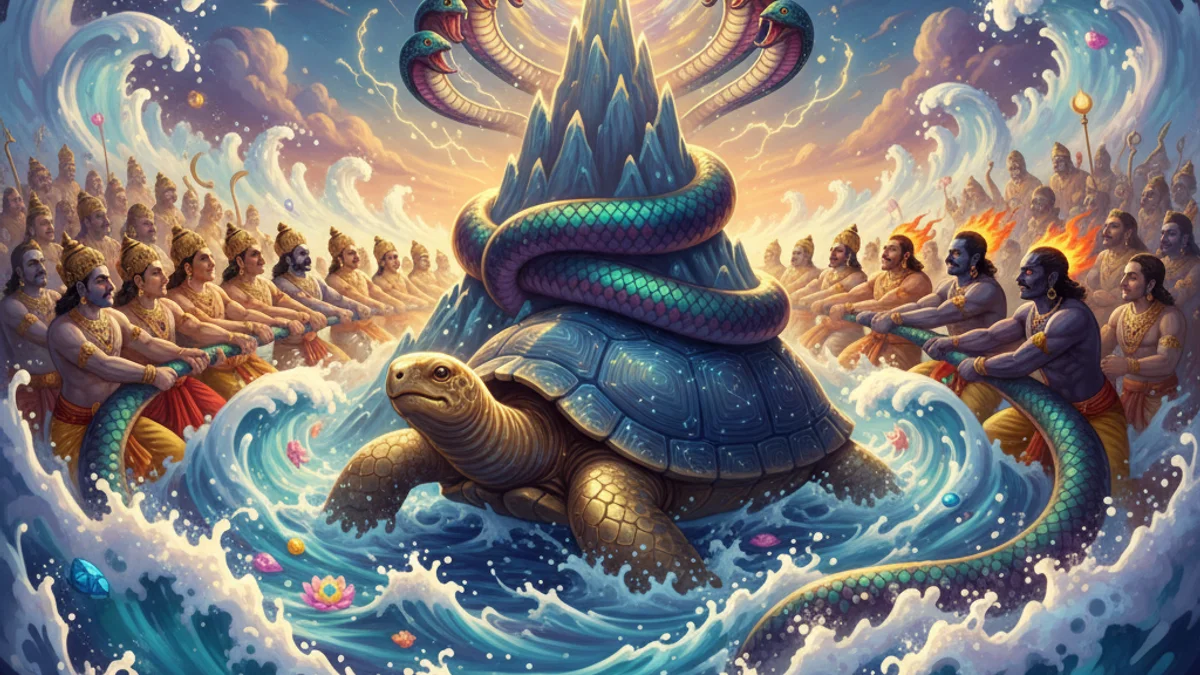
Long ago, the Devas lost their divine strength due to the curse of the quick-tempered Sage Durvasa. Seizing this weakness, the Asuras gained control of the three worlds. To regain their power, Lord Vishnu advised the Devas to churn the Ksheera Sagara, the Ocean of Milk, to obtain Amrita, the nectar of immortality. Realizing the task was too monumental to achieve alone, the Devas formed a temporary alliance with the Asuras. They used Mount Mandara as the churning rod and the great serpent Vasuki as the rope. However, as the churning began, the heavy mountain lacked a base and started sinking into the soft ocean floor. To save the mission, Lord Vishnu assumed the form of Kurma, a colossal tortoise. He dove to the depths of the ocean and supported the mountain on his vast, impenetrable shell. With this stable foundation, the churning continued for years, eventually yielding many divine treasures, including Goddess Lakshmi and the precious Amrita, which allowed the Devas to restore balance to the universe.
Great achievements require cooperation between opposing forces and a steady, unwavering foundation to support the collective effort.
Questions about this story
What is the moral of Vishnu as Kurma?
The story teaches that success in monumental tasks requires collaboration and a stable, selfless foundation to support the weight of the endeavor.
Why did Vishnu take the form of a tortoise?
He became Kurma to provide a solid base for Mount Mandara, which was sinking into the ocean floor during the churning for the nectar of immortality.
What is the Samudra Manthan?
It is the 'Churning of the Ocean of Milk,' a key event in Hindu mythology where gods and demons worked together to retrieve divine treasures.
Who is Vasuki in this story?
Vasuki is the King of Serpents who allowed himself to be used as the churning rope, wrapped around Mount Mandara.
Advertisement

Good night.
