
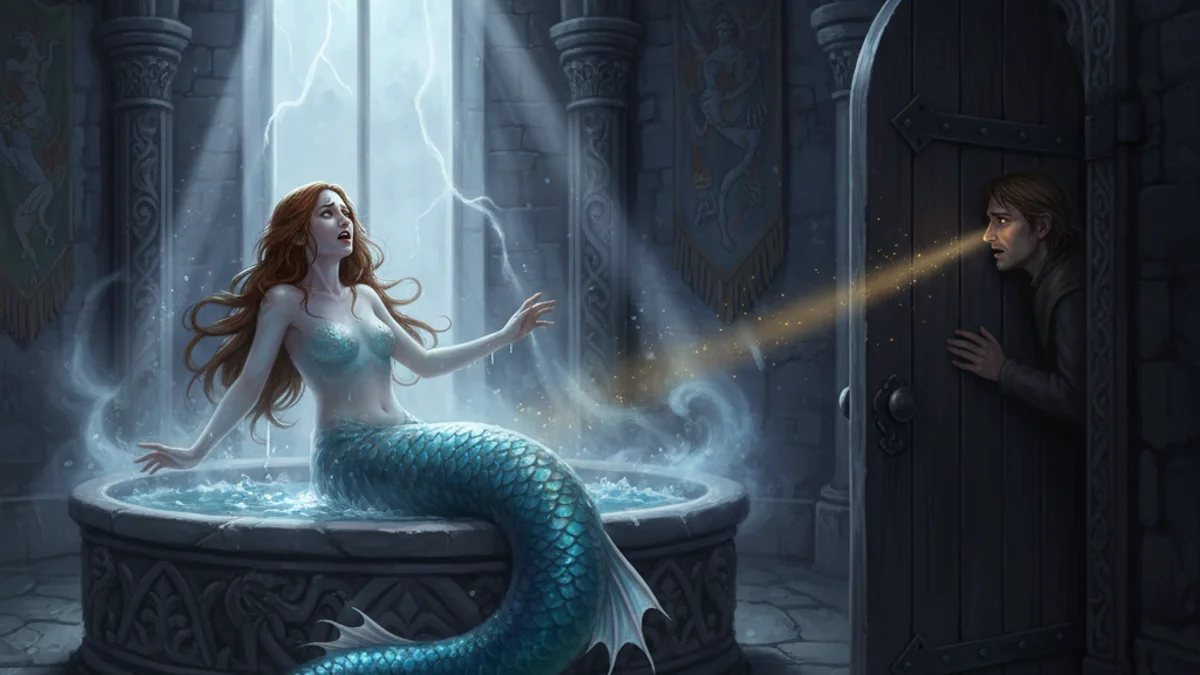
In the ancient forests of Poitou, a nobleman named Raymondin encountered a woman of ethereal beauty named Melusine by the Fountain of Thirst. Smitten, Raymondin accepted her hand in marriage, agreeing to her one condition: he must never seek her out on Saturdays. Under Melusine’s guidance, the house of Lusignan flourished; she used her magical arts to build magnificent castles and cities overnight, bearing Raymondin many sons. However, jealousy and curiosity eventually took hold. Spurred by his brother’s whispers, Raymondin spied on his wife through a keyhole one Saturday. He was horrified to see Melusine bathing, her lower half transformed into a massive, glistening serpent’s tail. He remained silent until a family tragedy drove him to call her a 'vile serpent' in a fit of rage. Exposed and heartbroken, Melusine transformed into a winged dragon, circling the castle three times with a mournful cry before vanishing into the mists, forever lost to the husband who broke his word.
True love requires absolute trust and the respect of boundaries; once a sacred promise is broken by curiosity, the bond is forever severed.
Questions about this story
What is the moral of Melusine?
The moral centers on the sanctity of trust and the consequences of broken promises. It teaches that prying into a partner's secrets against their explicit wishes can lead to the destruction of happiness and family.
Who is Melusine in European folklore?
Melusine is a feminine spirit of fresh water in sacred springs and rivers. She is famously associated with the House of Lusignan in France, where she is depicted as an ancestral mother and a powerful builder of castles.
Why did Melusine have a serpent's tail?
In many versions, Melusine was cursed by her mother, Pressyne, after she punished her father for breaking a similar promise. The curse forced her to take the form of a serpent or fish from the waist down every Saturday.
Is Melusine a mermaid or a dragon?
She is a shapeshifter who exhibits traits of both. While she is usually a woman with a serpent's tail in water, she transforms into a winged dragon when she is forced to leave her husband and the human world.
Advertisement
Good night.
