
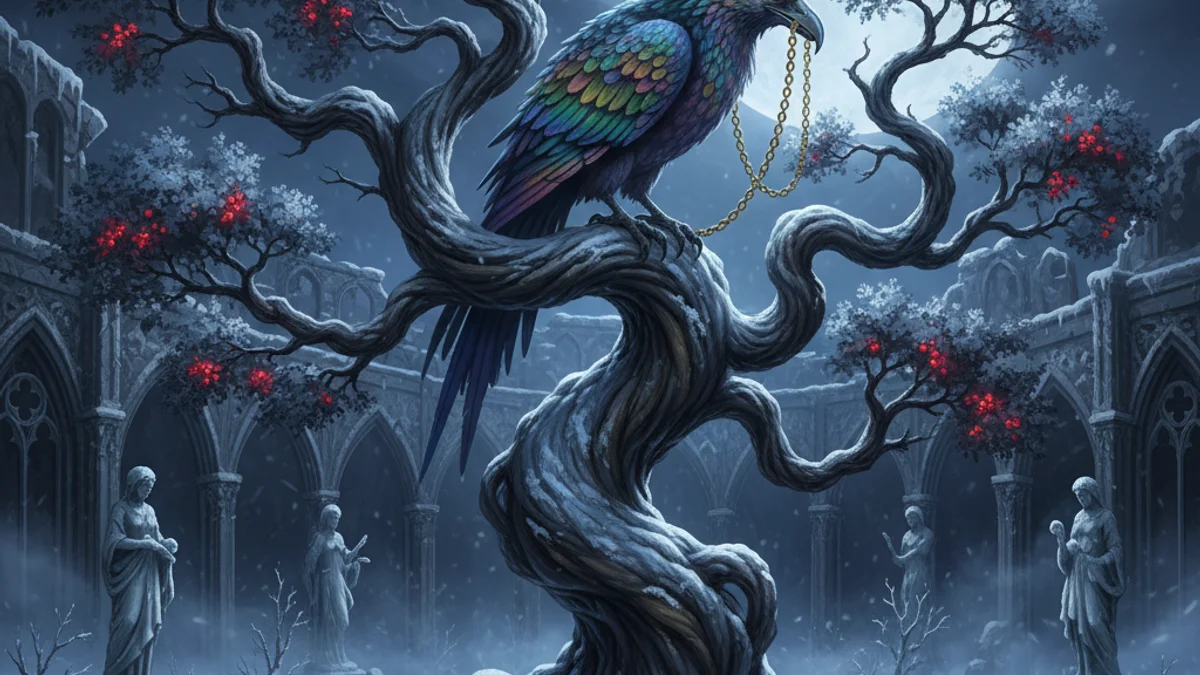
A long time ago, a pious woman wished for a child as white as snow and as red as blood while peeling an apple under a juniper tree. Her wish was granted, but she died of joy and was buried beneath the tree. Her husband eventually remarried a woman who had a daughter named Marlinchen. The stepmother, consumed by jealousy, hated the man's young son. One day, she lured the boy to a heavy chest and slammed the lid, decapitating him. To hide her crime, she cooked the boy into a stew and fed it to his father, who found it strangely delicious. Marlinchen, weeping, gathered her brother's bones and laid them under the juniper tree. Suddenly, a mist arose, and a beautiful bird emerged from the branches, singing a haunting song of his fate. The bird flew to a goldsmith, a shoemaker, and a miller, singing his tale and collecting a gold chain, red shoes, and a millstone. Returning home, he gave the chain to his father and the shoes to Marlinchen. When the stepmother came outside, he dropped the millstone on her, crushing her. In a flash of fire, the boy was restored to life, and the family lived in peace.
The truth cannot be buried, and those who commit great evils will eventually face divine justice and retribution.
Questions about this story
What is the moral of The Juniper Tree?
The story teaches that evil deeds cannot remain hidden and that justice will eventually prevail through truth. It also emphasizes the restorative power of love and memory.
Is The Juniper Tree one of the darkest Grimm stories?
Yes, it is infamous for its graphic themes of child murder, cannibalism, and gruesome revenge, which are much more intense than modern children's stories.
What does the bird symbolize in the story?
The bird represents the boy’s soul and the persistence of truth, acting as a messenger of justice who gathers the tools needed for retribution.
How does the stepmother die in the story?
After the bird rewards the father and sister, it drops a massive stone millstone onto the stepmother's head, crushing her instantly as a form of divine punishment.
Advertisement

Good night.
