Story Summary
Discover The Legend of Hiawatha, the story of a visionary leader who united the Five Nations to bring lasting peace and justice to the Great Lakes region.
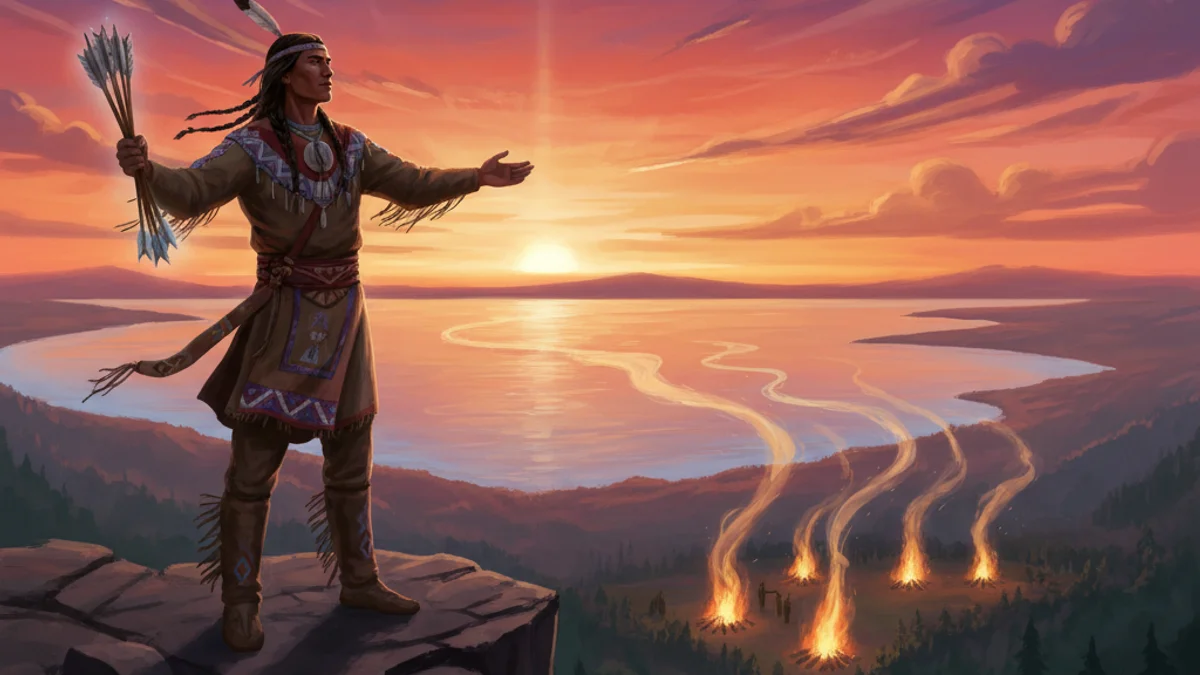
Long ago, in a time of endless strife among the Iroquois people, a man named Hiawatha lived in deep sorrow. War had claimed his family and his village, leaving him to wander the forests in grief. It was during this dark time that he met the Great Peacemaker, Deganawida. Deganawida shared a vision of a Great Law of Peace, where the Five Nations—the Mohawk, Oneida, Onondaga, Cayuga, and Seneca—would live as one family. Hiawatha, moved by this divine purpose, became the Peacemaker's voice, as Deganawida spoke with a stammer. Together, they traveled across the lands, confronting the most powerful and feared chiefs. Hiawatha used the metaphor of a single arrow being easy to break, while a bundle of five arrows remained unbreakable. Through patience, diplomacy, and the ritual of the wampum, they convinced the tribes to bury their weapons of war beneath the Great Tree of Peace. The Iroquois Confederacy was born, establishing a democratic union that would last for centuries, proving that the power of the mind and heart is stronger than the force of the club.
The Moral
Unity and cooperation create a strength that cannot be broken, while division leads only to destruction.
“A single arrow is easily broken, but five arrows bound together are invincible.”
Fun Fact
The Iroquois Confederacy's Great Law of Peace is often cited by historians as a significant influence on the framers of the United States Constitution.
Frequently Asked Questions
What is the moral of The Legend of Hiawatha?
The moral is that unity is the ultimate source of strength. By setting aside individual grievances for the common good, communities can achieve lasting peace and security that war can never provide.
Was Hiawatha a real person?
Yes, Hiawatha was a historical figure from the 15th or 16th century. He was a leader of the Onondaga and Mohawk people and a co-founder of the Iroquois Confederacy.
What is the Great Law of Peace?
It is the oral constitution of the Iroquois Confederacy. It established a democratic system of government, including checks and balances and the participation of both men and women in tribal decisions.
How does the legend differ from Longfellow's poem?
Longfellow's poem 'The Song of Hiawatha' is a work of fiction that blends the names of historical figures with unrelated Ojibwe legends. The actual legend focuses on the formation of the Iroquois Confederacy in New York.
What tribes were united by Hiawatha?
The confederacy originally included the Mohawk, Oneida, Onondaga, Cayuga, and Seneca tribes. They were later joined by the Tuscarora to become the Six Nations.
What does the bundle of arrows symbolize?
The bundle of arrows represents the strength found in numbers. While one tribe could be defeated easily, the five united tribes were invincible against their enemies.
Discussion (0)
Share your thoughts on this story
No comments yet. Be the first to share your thoughts!