
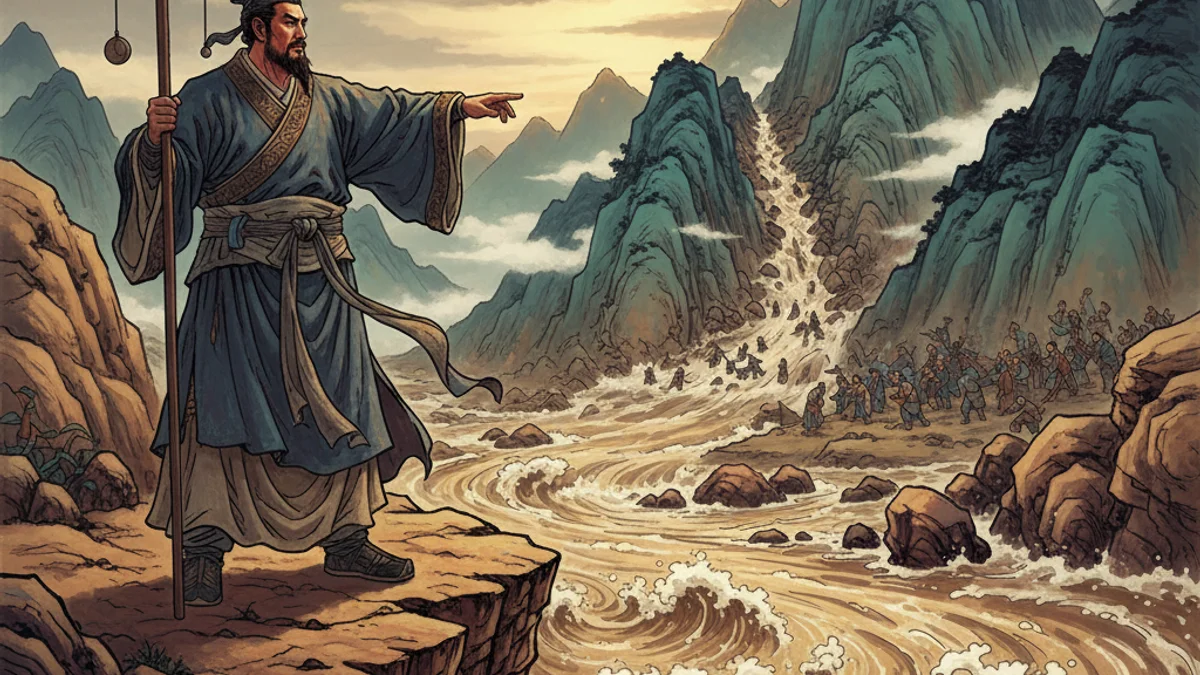
For generations, the Yellow River valley was plagued by catastrophic flooding that destroyed crops and homes. Gun, a nobleman, attempted to stop the waters by building massive dams and dikes, but the water only rose higher and broke through his barriers. After Gun’s failure, his son Yu was tasked with the monumental challenge. Unlike his father, Yu realized that the water could not be blocked; it had to be guided. For thirteen years, Yu labored alongside the common people, digging channels and dredging rivers to lead the floodwaters toward the sea. He was so dedicated to his mission that although he passed his own home three times during his travels, he never once entered, fearing that even a moment’s distraction would cost lives. His strategy of working with nature rather than against it succeeded. The lands were drained, the soil became fertile again, and the people flourished. In recognition of his wisdom, engineering brilliance, and selflessness, Yu was eventually chosen to become the emperor, founding the Xia Dynasty.
Success is achieved through persistence, selfless devotion to the public good, and the wisdom to work with the forces of nature rather than trying to suppress them.
Questions about this story
What is the moral of Yu the Great's Flood?
The story emphasizes the importance of perseverance and self-sacrifice for the common good. It also teaches that solving problems requires understanding their nature rather than using brute force.
How did Yu stop the flood differently than his father?
While his father, Gun, tried to block the water with dams and dikes, Yu realized the water needed a path. He designed a system of irrigation channels and dredged riverbeds to guide the water to the ocean.
Why did Yu not visit his family for thirteen years?
Yu was so dedicated to his duty that he refused to stop working until the flood was controlled. He famously passed his own home three times but did not enter, believing his personal life was secondary to the survival of the people.
Is Yu the Great a real historical figure?
Yu is considered the semi-mythical founder of the Xia Dynasty. While his life is steeped in legend, recent archaeological evidence suggests a massive flood occurred in the Yellow River valley around 1900 BCE, potentially grounding the story in history.
Advertisement
Good night.
