
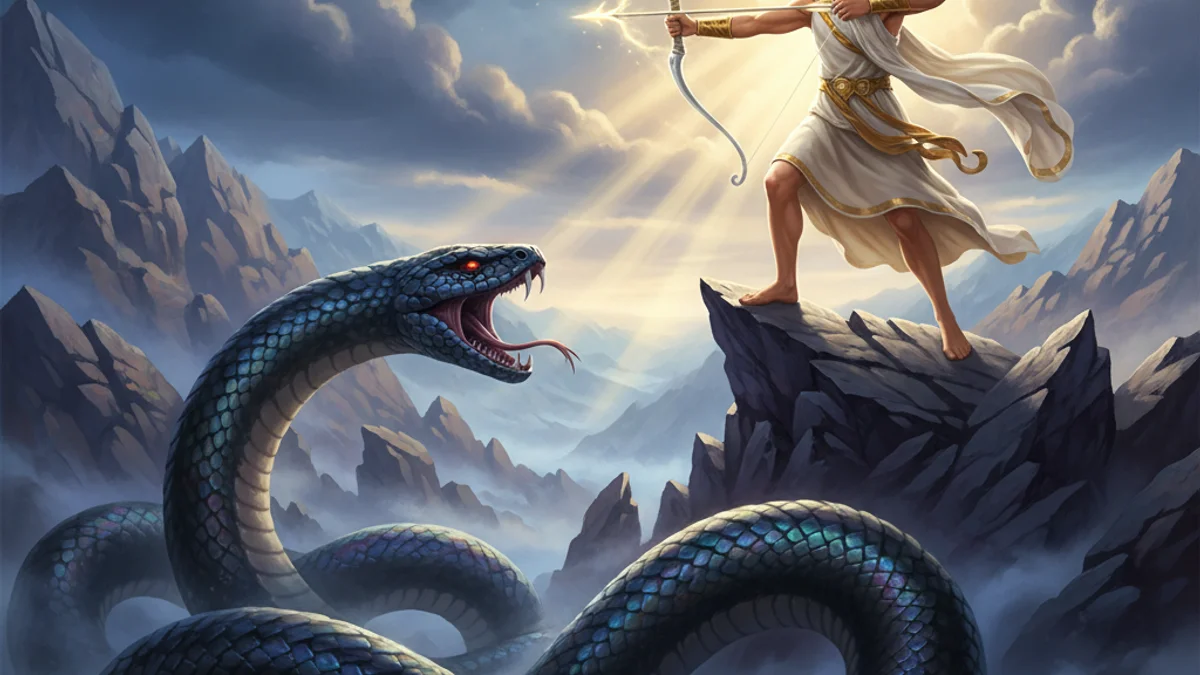
Born on the island of Delos, the young god Apollo grew with supernatural speed, fueled by ambition and the need to protect his mother, Leto. The goddess Hera, fueled by jealousy, had sent the monstrous serpent Python to hunt Leto during her pregnancy. Armed with a silver bow and a quiver of golden arrows crafted by Hephaestus, Apollo tracked the beast to the dark crags of Mount Parnassus near Delphi. The Python was a child of Gaia, a creature of primordial slime and shadow that guarded the ancient oracle. When they met, the serpent lunged with venomous fangs, but Apollo stood his ground, unleashing a hail of arrows that pierced the monster's scales. As the beast succumbed, its massive body fell into a chasm, and Apollo claimed the site for his own. To atone for shedding the blood of a child of Earth and to celebrate his victory, he established the Pythian Games, transforming a place of terror into the center of the ancient world's wisdom.
The light of reason and order can overcome the most primitive forces of chaos and darkness.
Questions about this story
What is the moral of Apollo Slays Python?
The story represents the triumph of divine order and enlightenment over primitive chaos. It teaches that even gods must face challenges and undergo purification to earn their place of authority.
Why did Apollo kill the Python?
Apollo sought revenge because Python had been sent by Hera to relentlessly pursue his mother, Leto, while she was pregnant with him. Additionally, Apollo wished to claim the sacred site of Delphi for his own oracle.
Where did the battle take place?
The legendary battle occurred on the slopes of Mount Parnassus near Delphi. This location became the most important religious site in ancient Greece following the serpent's defeat.
What are the Pythian Games?
The Pythian Games were one of the four Panhellenic Games of Ancient Greece, held every four years at Delphi. Apollo established them to commemorate his victory over the Python.
Advertisement
Good night.
