
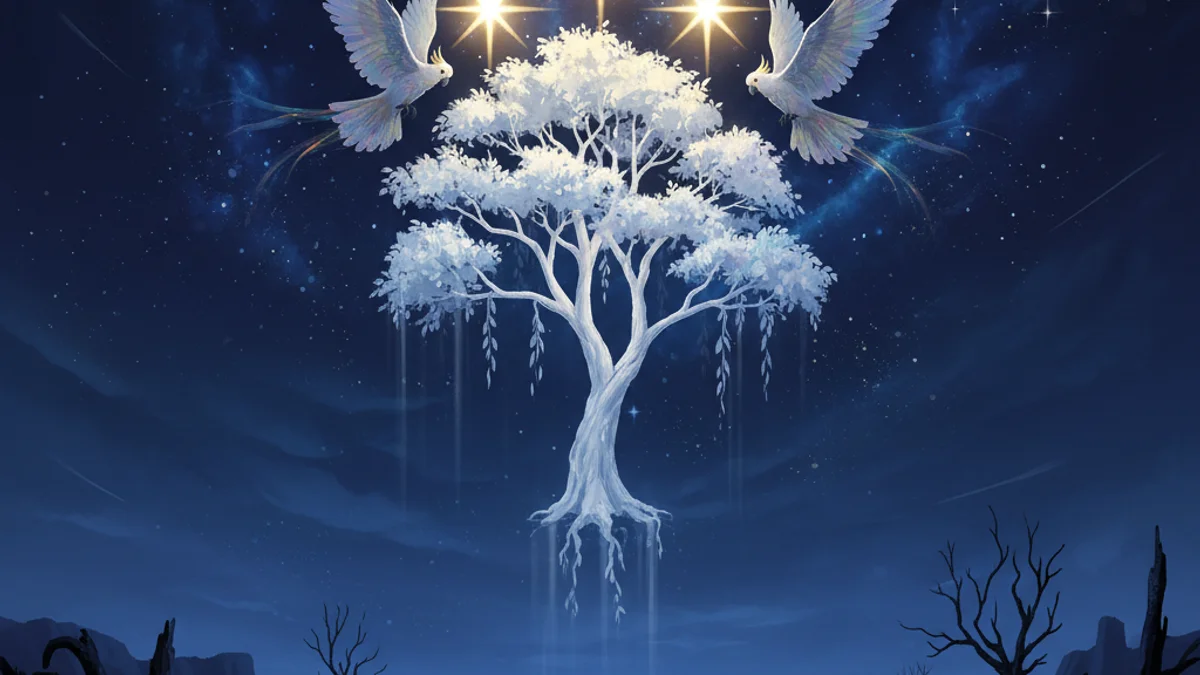
Long ago, when the world was new, the first man died. His spirit wandered the earth, confused by the cold silence of mortality. The Great Spirit, seeing his loneliness, reached down and lifted a massive white gum tree high into the heavens. As the tree ascended, two white cockatoos followed, their wings glowing in the dark. The man’s spirit settled at the peak, while the four brightest stars became the eyes of the spirit and the white birds. To those on Earth, this celestial sign became the Southern Cross, a beacon showing that even in death, one finds a place among the lights of the sky.
Death is not an ending but a transformation into a guiding light for others.
Advertisement
Questions about this story
What is the moral of The Southern Cross Origins?
The story teaches that death is a transition rather than an end. It suggests that those who pass before us remain as guiding lights to help the living find their way through the dark.
Which cultures have myths about the Southern Cross?
While famous in Australian Aboriginal culture, the Maori of New Zealand and various South American tribes also have unique legends. Most center on themes of navigation, ancestral spirits, or sacred animals.
What does the Southern Cross symbolize in Aboriginal culture?
It often symbolizes the transition to the spirit world or a celestial protector. In some versions, the stars represent the eyes of a death-spirit or the tracks of a great celestial emu.
Why is the Southern Cross so famous?
It is one of the most distinctive features of the southern night sky and serves as a vital navigational tool for finding south. Its cultural weight is evidenced by its presence on several national flags.
Advertisement
