
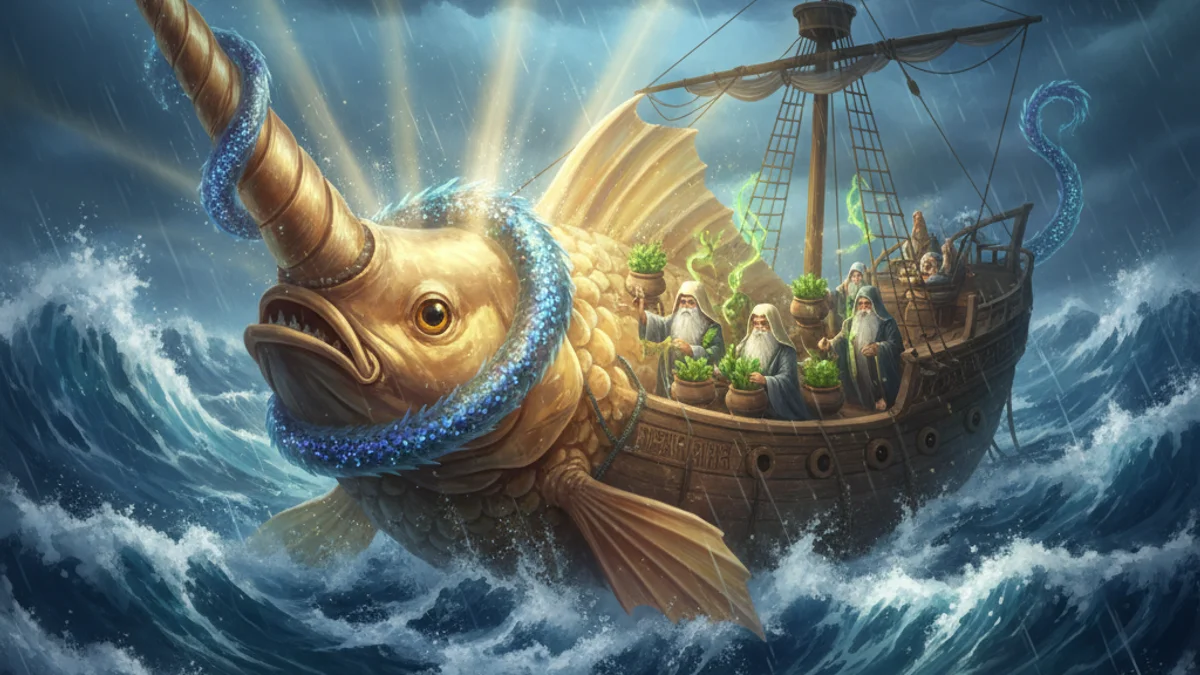
King Satyavrata was performing his morning prayers by the river when a tiny fish swam into his palms, pleading for protection from larger predators. Moved by compassion, the king placed the fish in a jar. By the next morning, the fish had outgrown the jar. He moved it to a pond, then a river, and finally the ocean, yet the fish continued to grow at a miraculous rate. Realizing the creature was divine, Satyavrata bowed. Lord Vishnu revealed himself and warned that a great deluge would destroy the world in seven days. He commanded the king to build a massive ship and gather the seven celestial sages, medicinal herbs, and seeds of every living thing. When the storm arrived, Vishnu appeared as Matsya, a golden, one-horned fish. Using the serpent Vasuki as a rope, Matsya tethered the ship to his horn and guided the survivors through the dark, turbulent waters, preserving life and the sacred Vedas for the next cycle of creation.
Compassion toward the smallest living things can lead to divine grace and the salvation of the world.
Questions about this story
What is the moral of Vishnu as Matsya?
The story teaches that protecting the vulnerable leads to salvation and that the divine guides those who are righteous. It also highlights the importance of preserving knowledge and life during times of global upheaval.
Why did Vishnu take the form of a fish?
Vishnu took the Matsya form to navigate the rising waters of a cosmic flood and to protect the seeds of life. This aquatic form allowed him to physically guide the ark through the storm and recover the stolen Vedas.
Who is King Manu in the story?
King Satyavrata, later known as Manu, is the virtuous leader chosen by Vishnu to survive the flood and become the progenitor of humanity. He is often compared to the biblical figure Noah due to his role in the deluge myth.
What is the significance of the one-horned fish?
The horn of Matsya served as a divine anchor point for Manu’s ship, allowing the serpent Vasuki to bind the vessel to the deity. It symbolizes the direct connection and protection the divine provides to those who surrender to it.
Advertisement
Good night.
