
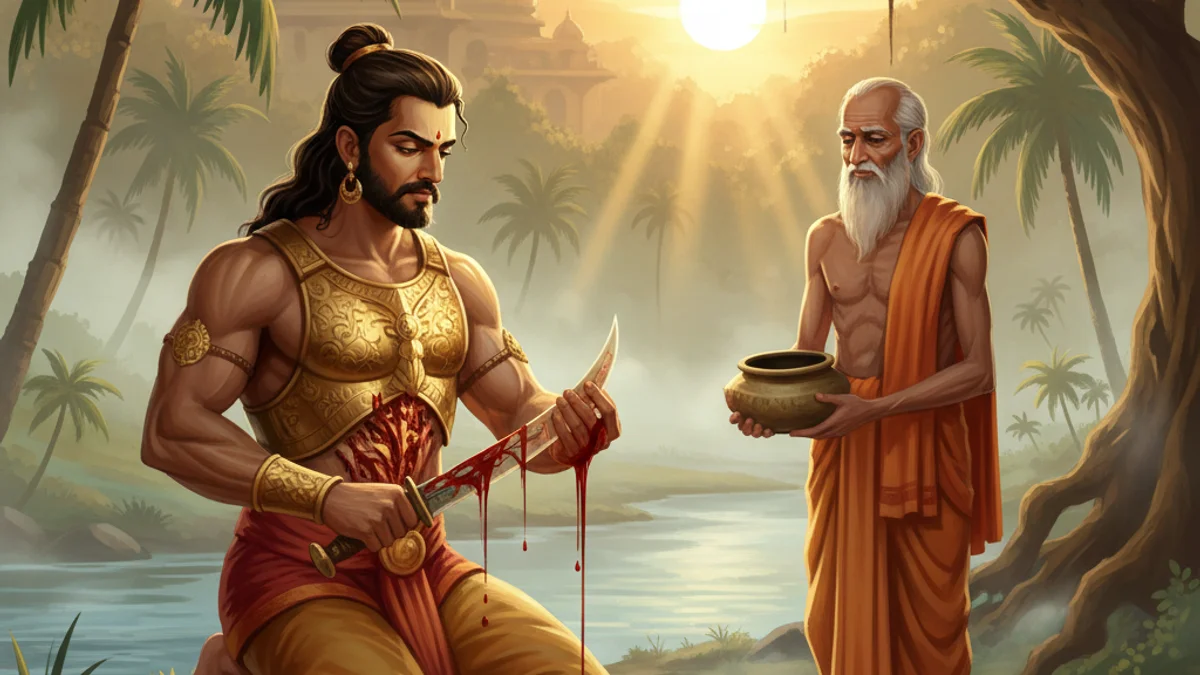
Born to Kunti and the Sun God Surya, Karna entered the world protected by a golden armor (Kavacha) and earrings (Kundala) fused to his skin, rendering him invincible. As the Great Kurukshetra War loomed, Lord Indra, father of Karna's rival Arjuna, feared for his son’s life. Disguised as a poor Brahmin, Indra approached Karna during his morning prayers—a time when the warrior never refused a beggar. Although his father Surya had warned him in a dream of Indra’s trickery, Karna’s commitment to charity was absolute. When the Brahmin asked for his armor and earrings, Karna did not hesitate. With a steady hand, he used a knife to cut the divine protection from his own body, handing the blood-stained items to the god. Moved by such peerless sacrifice, a humbled Indra granted Karna the powerful Vasavi Shakti weapon, though Karna knew that without his armor, his death on the battlefield was now inevitable.
True greatness is defined by one's unwavering commitment to their principles and charity, even when it requires the ultimate personal sacrifice.
Questions about this story
What is the moral of Karna's Armor?
The story emphasizes that integrity and the fulfillment of a vow are more important than life itself. It portrays Karna as the ultimate 'Daan-veer' or hero of charity.
Why did Indra ask for Karna's armor?
Indra, the king of gods, wanted to protect his son Arjuna in the upcoming war. He knew that as long as Karna wore the divine armor, he could not be defeated in battle.
Who gave Karna his armor and earrings?
Karna was born with the armor and earrings as a gift from his father, Surya, the Sun God. They were divine attributes that granted him immortality and protection from all weapons.
What did Indra give Karna in return for his sacrifice?
Ashamed of his own trickery, Indra granted Karna the Vasavi Shakti, a celestial dart that never missed its mark. However, Karna could only use it once before it returned to Indra.
Advertisement

Good night.
