
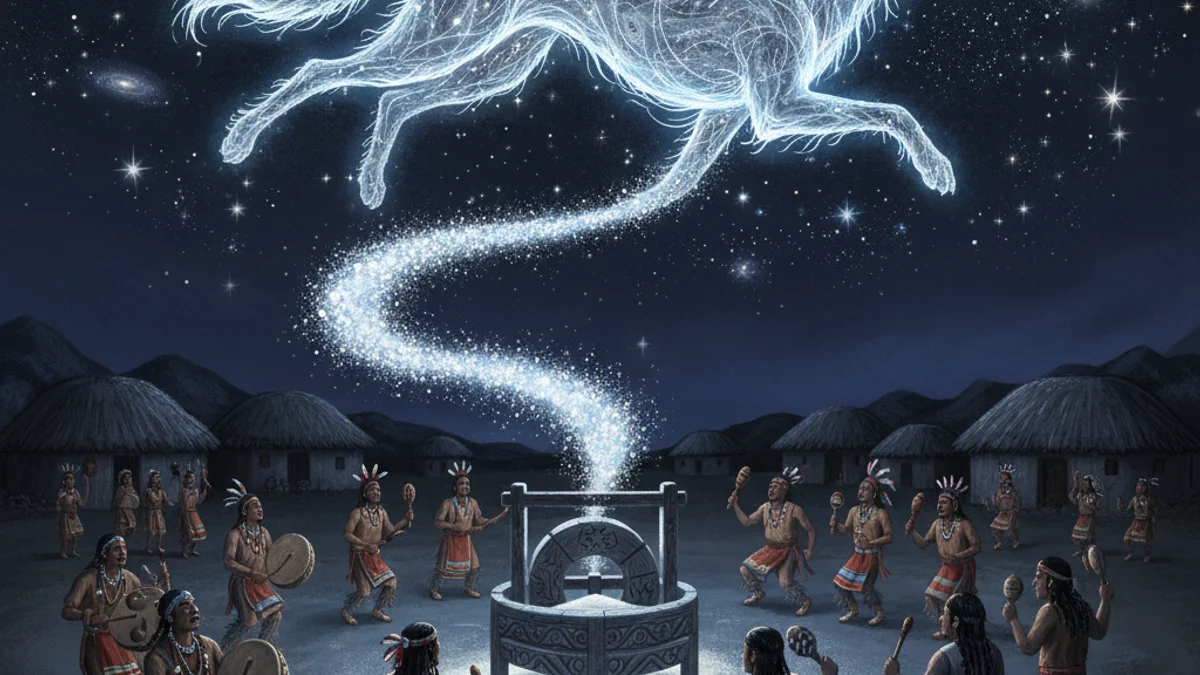
Long ago, when the world was young, the Cherokee people relied on cornmeal as their most precious food. One morning, an elderly couple discovered that their drying cornmeal had been pillaged during the night. They found giant paw prints leading away from their mill. Fearing a great spirit was at work, they sought the help of the village elders and a wise medicine man. The villagers gathered with drums and rattles, hiding near the mill as darkness fell. Suddenly, a massive spirit dog descended from the heavens and began to lap up the meal. At a signal, the people leaped out, banging their drums and shouting with all their might. The dog was so terrified by the cacophony that it bounded high into the sky, fleeing toward the north. As it ran, the white cornmeal spilled from its mouth, trailing across the black expanse of the night. These scattered grains became the stars, creating the shimmering path we now call the Milky Way, or 'Where the Dog Ran.'
Cooperation and collective action can protect a community's resources and transform a misfortune into lasting beauty.
Questions about this story
What is the moral of The Milky Way?
The story emphasizes the importance of community unity and how working together can solve problems. It also suggests that even a frightening event can result in something beautiful and permanent for the world to see.
Which tribe told the story of the spirit dog and the cornmeal?
This specific creation story originates from the Cherokee people of the Southeastern United States. They call the Milky Way 'Gili-utsunstanunyi,' which means 'Where the dog ran.'
What does the Milky Way represent in this legend?
In this legend, the Milky Way represents the trail of white cornmeal spilled by a giant dog as it was chased across the sky. It serves as a celestial map of a significant event in the tribe's folklore.
Why did the villagers use drums and rattles instead of weapons?
The villagers chose to frighten the spirit dog away with noise rather than harming it with weapons. This reflects a cultural preference for using cleverness and sound to resolve conflicts with spiritual entities.
Advertisement



Good night.
