
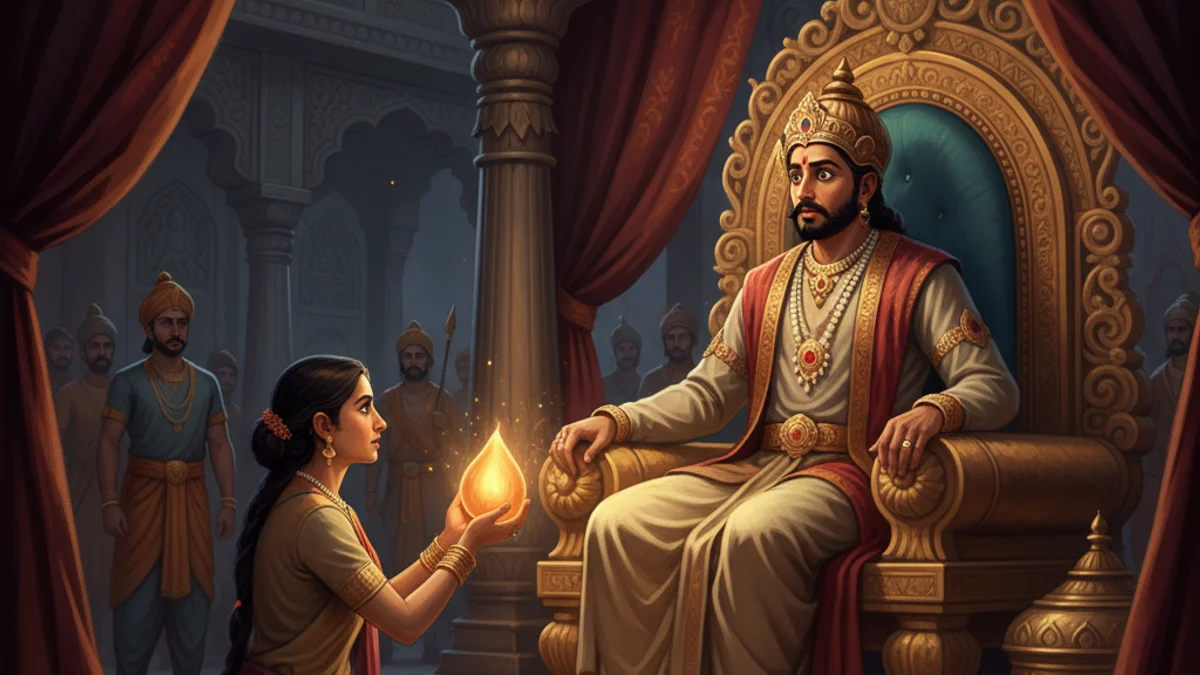
King Bharthari of Ujjain once received a mystical fruit from a sage that granted immortality to whoever ate it. Deeply in love with his wife, Queen Pingala, the King decided she deserved the gift more than he did and gave it to her. However, the Queen was secretly in love with the head of the royal stables and gave the fruit to him instead. The stable master, in turn, was enamored with a common prostitute and presented the fruit to her as a token of his affection. Struck by the King’s virtue and her own low station, the prostitute decided that a great ruler should live forever rather than someone like her. She brought the fruit back to the palace and gifted it to Bharthari. Shocked to see the same fruit return to him, the King investigated its journey and uncovered the web of betrayal. Realizing the transience of human desires and the fickleness of love, he renounced his crown to live as an ascetic, eventually passing the throne to his brother, King Vikramaditya.
True fulfillment comes from detachment and wisdom rather than the pursuit of worldly pleasures or the blind trust of those driven by desire.
Questions about this story
What is the moral of The Magic Fruit?
The story teaches that worldly attachments and desires are often deceptive. It emphasizes that true peace is found in detachment and the realization that human loyalty can be fickle.
Who gave the magic fruit to King Bharthari?
The fruit was given to King Bharthari by a sage who had performed great penance. The sage believed the King was the most deserving person to live forever because of his noble rule.
Why did King Bharthari renounce his throne?
He was heartbroken by his wife's betrayal and disillusioned by the cycle of unrequited love involving the stable master and the prostitute. This led him to seek a life of spiritual asceticism.
How did the fruit return to the King?
The fruit traveled from the King to the Queen, then to the stable master, and finally to a prostitute. The prostitute, out of respect for the King's goodness, returned it to him as a gift.
Advertisement

Good night.
