
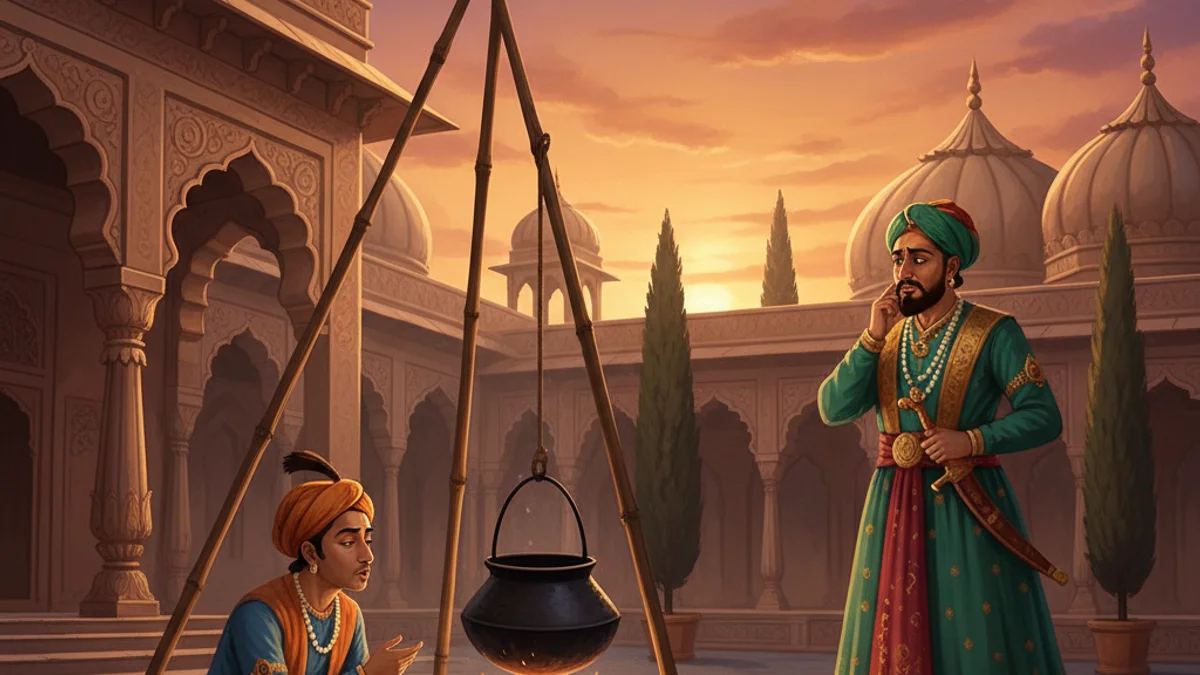
On a freezing winter evening, Emperor Akbar and his advisor Birbal walked past a lake. Akbar wondered aloud if a man would do anything for money, even stand in the icy water overnight. A poor Brahmin, desperate to feed his family, accepted the challenge. He stood in the chest-deep water until dawn, shivering but resolute. However, when he asked for his reward, Akbar refused, claiming the man survived by drawing warmth from a distant street lamp on the shore. Heartbroken, the Brahmin sought Birbal's help. The next day, Birbal did not show up at court. When Akbar visited his home, he found Birbal sitting by a small fire on the ground, with a pot of khichdi hanging several feet above it on a tall tripod. Akbar laughed, saying the heat would never reach the pot. Birbal calmly replied, 'If a distant lamp can warm a man in a cold lake, then this fire can surely cook my khichdi.' Realizing his unfairness, Akbar rewarded the Brahmin generously.
Logic must be applied consistently and fairly. It also teaches that wit can be a powerful tool to expose injustice and speak truth to power.
Questions about this story
What is the moral of Birbal's Khichdi?
The moral is that logic should be applied fairly and one should not use weak excuses to cheat others. It also highlights how wit can be used to rectify an injustice.
How did Birbal cook the khichdi to prove his point?
Birbal hung the cooking pot high above a small fire using a tall tripod. He did this to demonstrate to Akbar that heat cannot travel such a great distance, mirroring the absurdity of the lamp argument.
Why did Akbar initially refuse to pay the Brahmin?
Akbar argued that the Brahmin cheated by looking at a distant street lamp for warmth. He used this as a flimsy excuse to avoid paying the promised reward for the difficult task.
Is Birbal's Khichdi a true historical event?
While Akbar and Birbal were real historical figures, these stories are generally considered folklore. They were likely composed to celebrate Birbal's legendary wit and his relationship with the Emperor.
Advertisement
Good night.
