
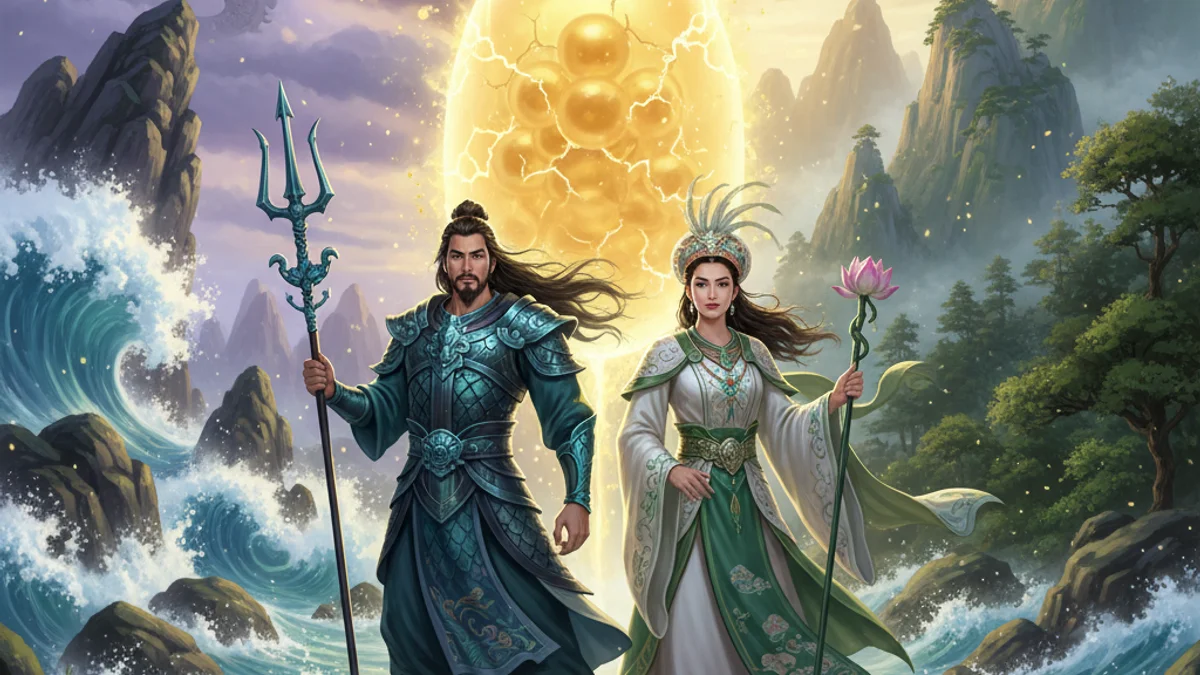
In the ancient mists of time, Lạc Long Quân, a mighty Dragon Lord of the sea, encountered the beautiful fairy princess Âu Cơ from the high mountains. Their love blossomed, and they wed, representing the union of the water and the earth. Soon, Âu Cơ gave birth to a miraculous sac containing one hundred eggs, which hatched into one hundred strong, intelligent sons. However, the couple realized that their different natures—one belonging to the depths of the ocean and the other to the peaks of the mountains—made it difficult to live together forever. With heavy hearts, they agreed to divide their children to ensure the prosperity of the land. Lạc Long Quân took fifty sons to the coastal regions, while Âu Cơ led fifty sons to the highlands. The eldest son remained in the plains of Phong Châu to become Hùng Vương, the first king of the Vietnamese people. This legend established the eternal bond of the Vietnamese people as 'Con Rồng Cháu Tiên'—the Children of the Dragon and the Grandchildren of the Fairy.
The legend teaches the importance of national unity and shared heritage, reminding us that all people are brothers and sisters born from the same source.
Questions about this story
What is the moral of The Hundred-Egg Legend?
The moral is that all Vietnamese people share a common ancestry and should live in harmony and unity. It emphasizes that despite living in different regions, everyone belongs to the same 'sac of eggs' or family.
Who are Lạc Long Quân and Âu Cơ?
Lạc Long Quân was a powerful Dragon Lord from the sea, and Âu Cơ was a beautiful mountain fairy. Together, they are considered the ancestral father and mother of the Vietnamese civilization.
What does 'Con Rồng Cháu Tiên' mean?
The phrase translates to 'Children of the Dragon, Grandchildren of the Fairy.' It is a proud cultural identity used by Vietnamese people to describe their divine and mythical origins.
Why did the couple decide to separate?
Lạc Long Quân explained that as a creature of water and a creature of land, their habits and environments were too different to remain together. They separated to govern and protect both the mountains and the sea.
Advertisement
Good night.
