
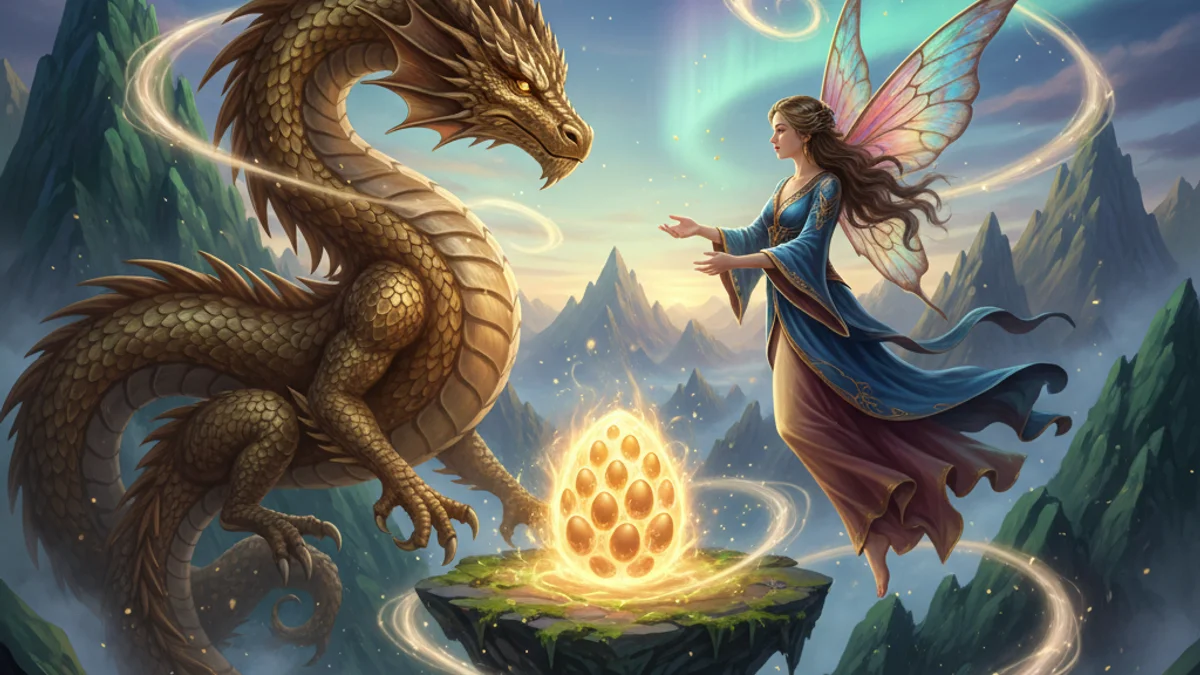
Long ago, in the land of Linh Nam, lived Lạc Long Quân, a powerful Dragon Lord of the sea, and Âu Cơ, a beautiful celestial Fairy from the high mountains. They fell in love and married, a union of water and fire. Soon after, Âu Cơ gave birth to a sac containing one hundred eggs, which hatched into one hundred strong, handsome sons. However, the couple eventually realized their different natures could not be reconciled forever. Lạc Long Quân longed for the depths of the ocean, while Âu Cơ yearned for the peaks of the mountains. They decided to part ways, with fifty sons following their father to the coast and fifty sons following their mother to the highlands. Before separating, they promised to support one another in times of need. The eldest son remained in Phong Châu and founded the kingdom of Văn Lang, becoming the first Hùng King. Thus, the Vietnamese people were born, known ever since as the 'Children of the Dragon and Grandchildren of the Fairy.'
Unity and national solidarity stem from a common ancestry, reminding us that all citizens are siblings from the same root.
Advertisement
Questions about this story
What is the moral of The Dragon and the Fairy?
The moral emphasizes national unity and the shared heritage of the Vietnamese people. It teaches that despite living in different regions, all citizens belong to the same family and should support one another.
Who were Lạc Long Quân and Âu Cơ?
Lạc Long Quân was a heroic Dragon Lord from the sea, and Âu Cơ was a beautiful celestial Fairy from the mountains. Their legendary marriage represents the ancestral origins of the Vietnamese people.
Why did the Dragon and the Fairy separate?
They separated because of their different elemental natures—one belonged to the water and the other to the mountains. They agreed to divide their children to manage both the lowlands and the highlands effectively.
What does the term 'Đồng bào' mean in relation to this story?
The term 'Đồng bào' literally translates to 'from the same womb.' It refers to the one hundred eggs born from Âu Cơ, symbolizing that all Vietnamese people are brothers and sisters.
Advertisement
