
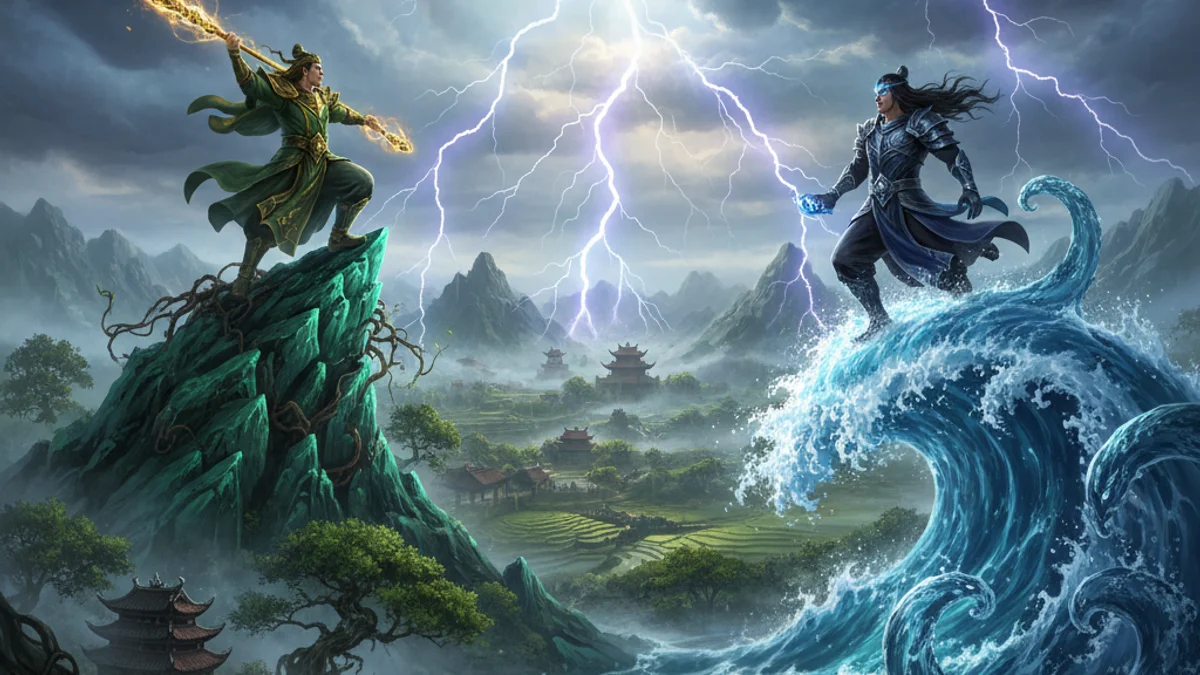
During the reign of the eighteenth Hung King, the monarch sought a worthy husband for his beautiful daughter, Princess My Nuong. Two extraordinary suitors appeared: Son Tinh, the Lord of the Mountains, and Thuy Tinh, the Lord of the Waters. Both possessed immense power; Son Tinh could move mountains with a wave of his hand, while Thuy Tinh could summon storms and floods. Unable to choose between them, the King declared that whoever brought the wedding gifts first—a nine-tusked elephant, a nine-spurred rooster, and a nine-maned horse—would win the princess's hand. Son Tinh arrived at dawn the next day with the rare treasures and claimed his bride. When Thuy Tinh arrived late and found the princess gone, he flew into a jealous rage. He raised the sea levels and summoned torrential rains to drown the mountains. However, as the water rose, Son Tinh used his magic to make the mountains grow even higher. After months of battle, Thuy Tinh grew exhausted and retreated. Yet, every year since, he returns to raise the waters in vengeance, explaining the annual floods that sweep through the land.
The story illustrates the resilience of the human spirit against the forces of nature and the eternal struggle for balance in the environment.
Questions about this story
What is the moral of Son Tinh and Thuy Tinh?
The moral is that resilience and preparation can overcome natural disasters. It also serves as a cultural explanation for the cyclical and inevitable nature of environmental challenges.
Who are Son Tinh and Thuy Tinh?
Son Tinh is the God of the Mountains, representing the land and stability, while Thuy Tinh is the God of the Waters, representing the sea and unpredictable storms.
Why does Thuy Tinh attack every year?
Thuy Tinh attacks every year because he remains vengeful after losing Princess My Nuong to Son Tinh. His grief and anger manifest as the annual monsoon rains and flooding.
What gifts did the King require for the princess's hand?
The King demanded three mythical animals: a nine-tusked elephant, a nine-spurred rooster, and a nine-maned horse. These rare creatures tested the gods' reach across the land.
Advertisement


Good night.
