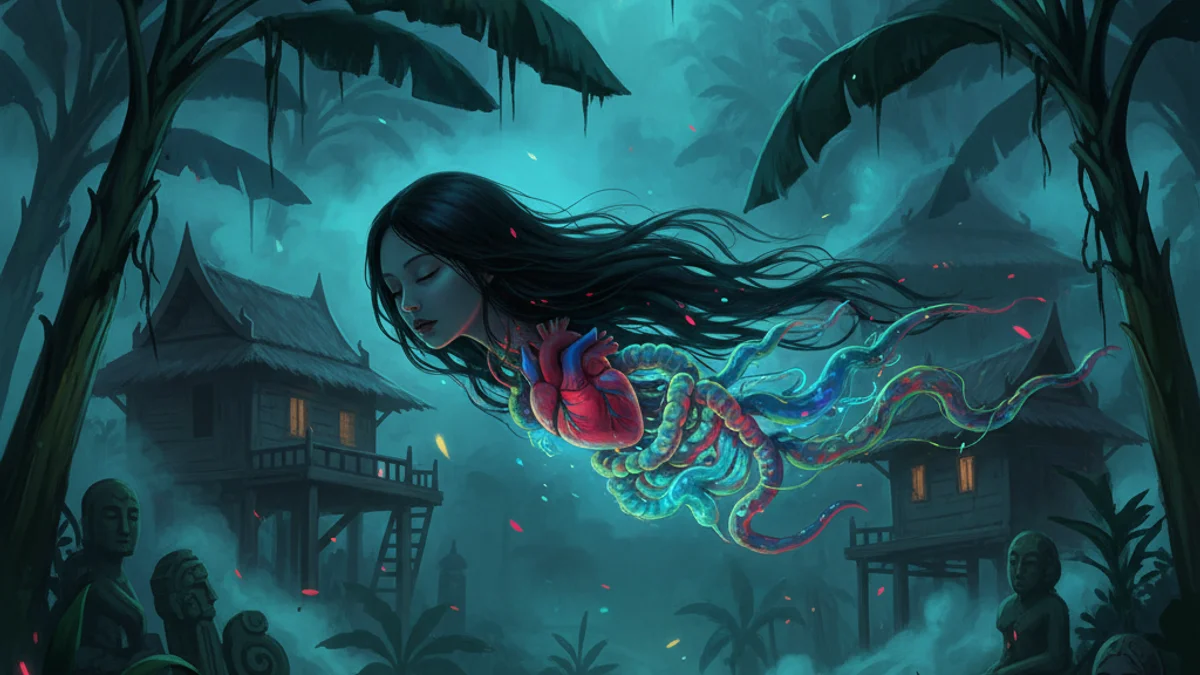
In the quiet villages of rural Thailand, there lives a woman who appears perfectly ordinary during the day. She is often beautiful, yet she carries a dark curse born of black magic or a forbidden transgression. As the sun sets and the village falls silent, her head detaches from her neck, pulling her heart, stomach, and a trail of glowing intestines along with it. This is the Krasue. Driven by an insatiable hunger, she floats through the night, emitting a dim, eerie glow as she searches for raw flesh, blood, or filth to consume. She is a creature of shadow and gluttony, forced to return to her headless body before the first light of dawn. Villagers, fearing her presence, often plant thorny fences around their homes, knowing that if her trailing organs become entangled in the sharp brush, she will be trapped and destroyed by the rising sun.
This legend serves as a warning against the pursuit of dark arts and the consequences of succumbing to insatiable, selfish desires.
Advertisement
Questions about this story
What is the moral of The Ghost of Krasue?
The story warns against the dangers of practicing black magic and harboring secret, gluttonous desires. It emphasizes that such dark paths lead to a loss of humanity and a life of eternal, agonizing hunger.
How did the Krasue become a ghost?
According to folklore, a woman becomes a Krasue through a curse or by practicing black magic that goes wrong. In some versions, the curse is passed down by consuming the saliva of a dying Krasue.
What are the weaknesses of a Krasue?
The Krasue is highly vulnerable to thorny plants because her trailing intestines can easily get snagged. She also cannot survive exposure to sunlight while detached from her body, as it will burn her exposed organs.
Is the Krasue story unique to Thailand?
While most famous in Thailand, similar spirits exist across Southeast Asia. These include the Penanggalan in Malaysia, the Leyak in Bali, and the Manananggal in the Philippines.
Advertisement