
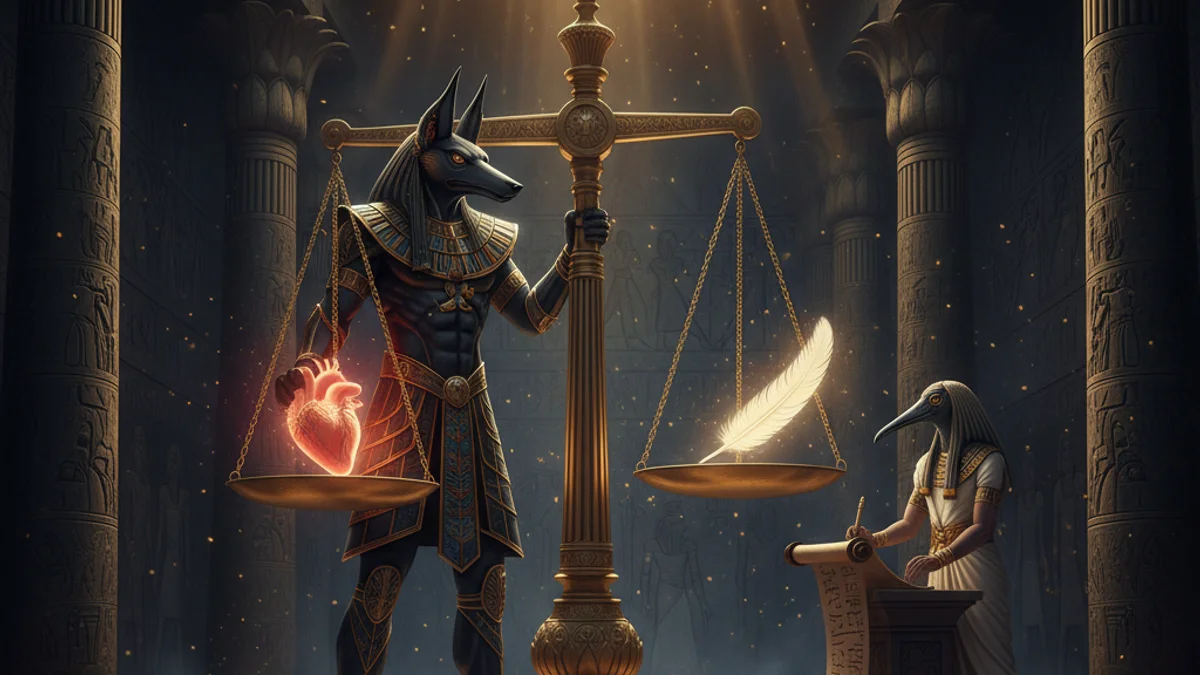
In the shadowed Hall of Two Truths, the jackal-headed god Anubis stands before the great golden scales. Beside him, the deceased soul waits in silent anticipation. Anubis reaches for the heart of the departed—the vessel of their deeds and memory—and places it on one side of the scale. On the other, he sets the white feather of Ma’at, the symbol of cosmic order and truth. Thoth, the ibis-headed scribe, stands ready with his stylus to record the divine verdict. If the heart is lighter than the feather, the soul is deemed pure and welcomed into the eternal paradise of the Reed Fields. However, if the heart is heavy with sin and greed, it tips the scale downward. Beneath the scales, the monstrous Ammit, Devourer of the Dead, waits with hungry jaws to consume the unworthy heart, ending the soul’s existence forever. This final judgment ensures that only those who lived with integrity may pass into the afterlife.
Your actions in life define your eternal legacy; live with truth and kindness so your heart remains light.
Questions about this story
What is the moral of Anubis and the Scales?
The moral is that integrity and truth are the ultimate measures of a person's worth. One must live a life of virtue to ensure their soul finds peace in the afterlife.
What happens if the heart is heavier than the feather?
If the heart is heavy with sin, it is immediately consumed by the demon Ammit. This results in the 'second death,' meaning the soul ceases to exist and cannot enter paradise.
Who is Anubis in Egyptian mythology?
Anubis is the ancient Egyptian god of mummification and the afterlife. He is typically depicted as a man with the head of a jackal and serves as the protector of the scales of justice.
What does the feather of Ma'at represent?
The feather represents Ma'at, the goddess of truth, balance, and order. It serves as the cosmic standard against which every human soul is judged for its moral purity.
Advertisement
Good night.
