
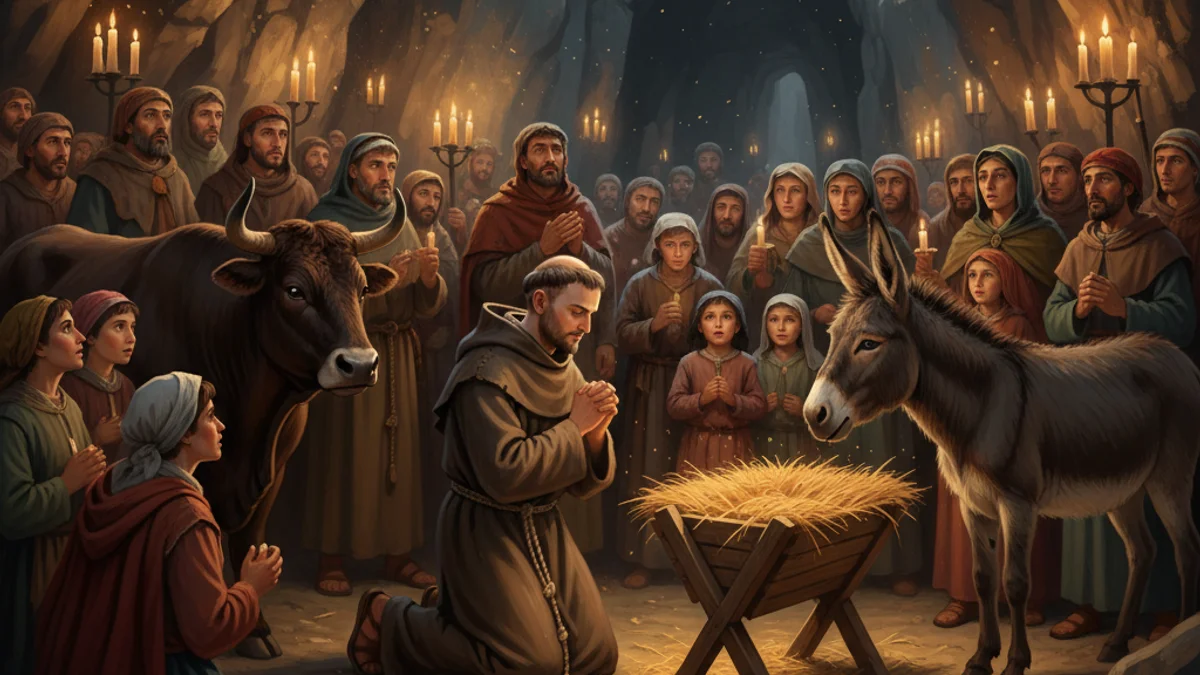
In the winter of 1223, in the small Italian village of Greccio, Saint Francis of Assisi felt a deep longing to celebrate Christmas in a way that would make the humble birth of Christ feel real to everyone. He called upon his friend Giovanni, saying, 'I wish to recall to memory the Child who was born in Bethlehem and see with my own eyes the hardships of His infant needs.' In a mountain cave, they prepared a simple manger filled with hay and brought in a live ox and an ass. On Christmas Eve, the friars and townspeople climbed the hill carrying torches and candles, their songs echoing through the woods. Francis stood before the manger, overcome with joy, preaching to the crowd about the 'Babe of Bethlehem.' Legend says that a vision appeared in the hay—a beautiful, glowing child whom Francis took in his arms. That night, the cold cave was transformed into a sanctuary of warmth and light, teaching the world that the greatest miracles are often found in the simplest of places.
True faith is found in simplicity and the humble recognition of love in the most modest circumstances.
Questions about this story
What is the moral of The First Nativity Scene?
The moral is that spiritual richness is found in humility and simplicity rather than material wealth. It teaches that the heart of faith lies in connecting with the human experience of the divine.
Where did the first nativity take place?
The first nativity scene was created in a cave near the village of Greccio, Italy. Saint Francis chose this location because it reminded him of the rugged landscape of Bethlehem.
Why did St. Francis create the live nativity?
He wanted to help people visualize the poverty and hardships Jesus faced at birth. By making the story physical and tangible, he aimed to stir deep devotion in the hearts of the common people.
When was the first nativity scene created?
The event took place on Christmas Eve in the year 1223. This tradition has since spread globally, becoming a staple of Christian Christmas celebrations.
Advertisement

Good night.
