
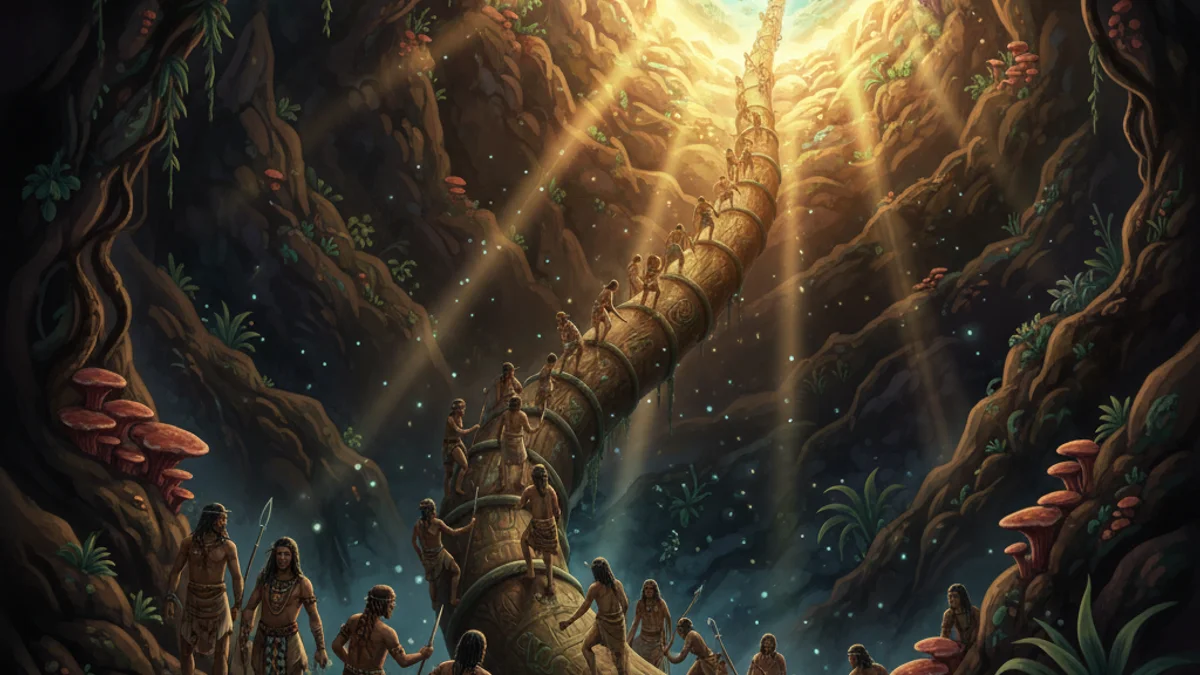
In the beginning, the First People lived in a series of dark, cramped worlds beneath the surface of the earth. Each world began in peace, but as the population grew, so did strife and disharmony. Seeking a better way of life, the people, guided by the wisdom of Spider Woman and the Holy Ones, began a vertical pilgrimage. They climbed through a succession of colored worlds—black, blue, and yellow—each representing a stage of spiritual growth. Eventually, they reached a great hollow reed that pierced the sky of the third world. One by one, they climbed through this bamboo-like stalk, emerging through a small opening called the Sipapu into the Fourth World—the world of light, color, and sun. Here, they were greeted by the vastness of the horizon and tasked with living in balance with the land, remembering always the journey they made from the shadows into the dawn.
True growth requires the courage to leave behind old ways of conflict to seek a life of harmony and light.
Questions about this story
What is the moral of The Emergence from the Underworld?
The moral is that spiritual and social evolution requires leaving behind darkness and conflict to find a path of harmony. It emphasizes the human capacity for growth and the constant search for enlightenment.
What does the 'Sipapu' represent in the story?
The Sipapu is the physical and spiritual portal or 'place of emergence' through which the first people entered the current world. It symbolizes the transition between states of being and the birth of humanity into the light.
Which Native American tribes tell this story?
Variations of the emergence myth are central to the traditions of the Southwestern tribes, particularly the Hopi, Navajo (Diné), Zuni, and other Pueblo peoples. Each tribe has its own unique details regarding the number of previous worlds.
Who is Spider Woman in this legend?
Spider Woman is a powerful deity and grandmother figure who provides the wisdom and guidance necessary for the people to survive. She often acts as a protector and teacher, helping the people navigate the transition between worlds.
Advertisement
Good night.
