
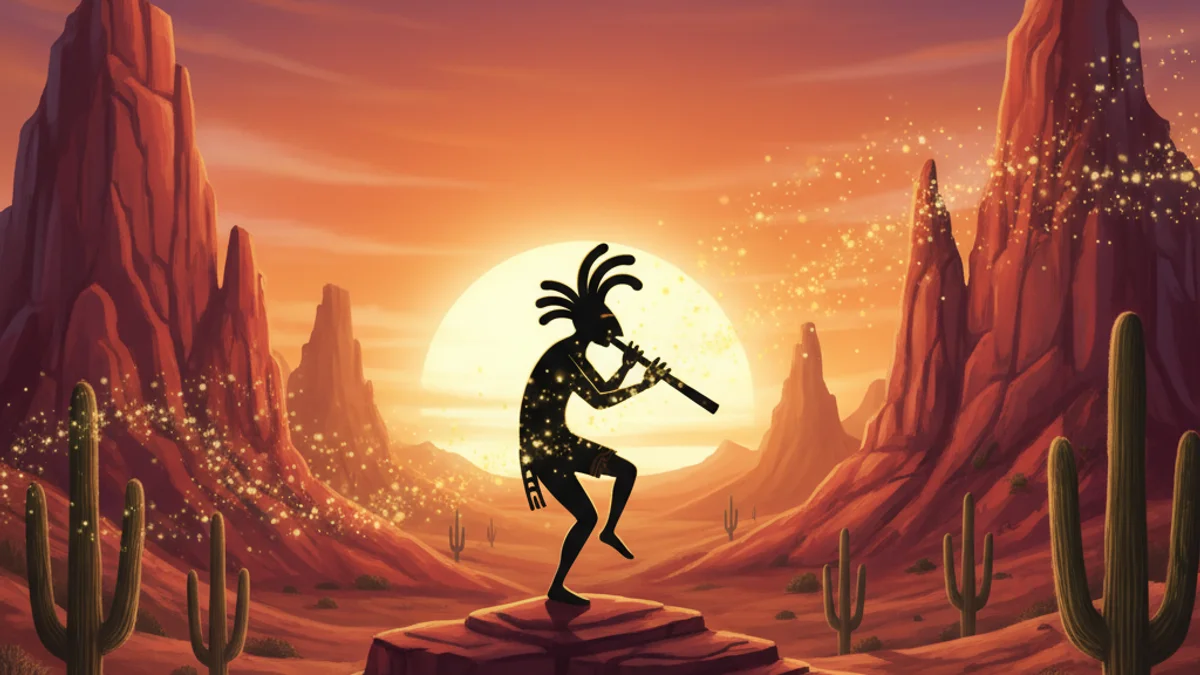
In the ancient canyons of the American Southwest, when the world was young and winter lingered too long, the people huddled in their cold dwellings. Then, from the horizon, came the silhouette of a traveler. This was Kokopelli, the hunchbacked flute player. As he walked from village to village, he carried a heavy sack upon his back, filled with seeds of every plant and the songs of every bird. He raised his flute to his lips, and as the first notes drifted through the air, the biting wind turned into a gentle breeze. Wherever he stepped, the snow melted and the parched earth drank. He played for the corn, and it sprouted; he played for the clouds, and they brought gentle rain. To the tribes, he was a hero of the harvest, a wandering spirit who transformed the barren desert into a garden of abundance. His music was not just sound, but the very breath of life that ensured the survival of the people through the changing seasons.
The spirit of joy and the harmony of nature can bring abundance and renewal even to the harshest environments.
Questions about this story
What is the moral of Kokopelli the Flute Player?
The story teaches that joy, music, and a connection to nature are essential for prosperity and survival. It highlights how a positive spirit can transform a barren landscape into a place of life and growth.
Who is Kokopelli in Native American mythology?
Kokopelli is a prehistoric deity or spirit often depicted as a humpbacked flute player. He is revered by several Southwestern tribes, including the Hopi and Zuni, as a symbol of fertility and agriculture.
Why does Kokopelli have a hump on his back?
In many legends, the hump represents a sack of seeds that he carries to plant across the world. In other versions, it is said to contain the songs he has collected or even the warmth of the sun.
What does the flute symbolize in this legend?
The flute symbolizes the breath of life and the transition of the seasons. Its music is the catalyst that turns winter into spring and encourages the crops to grow from the earth.
Advertisement

Good night.
