
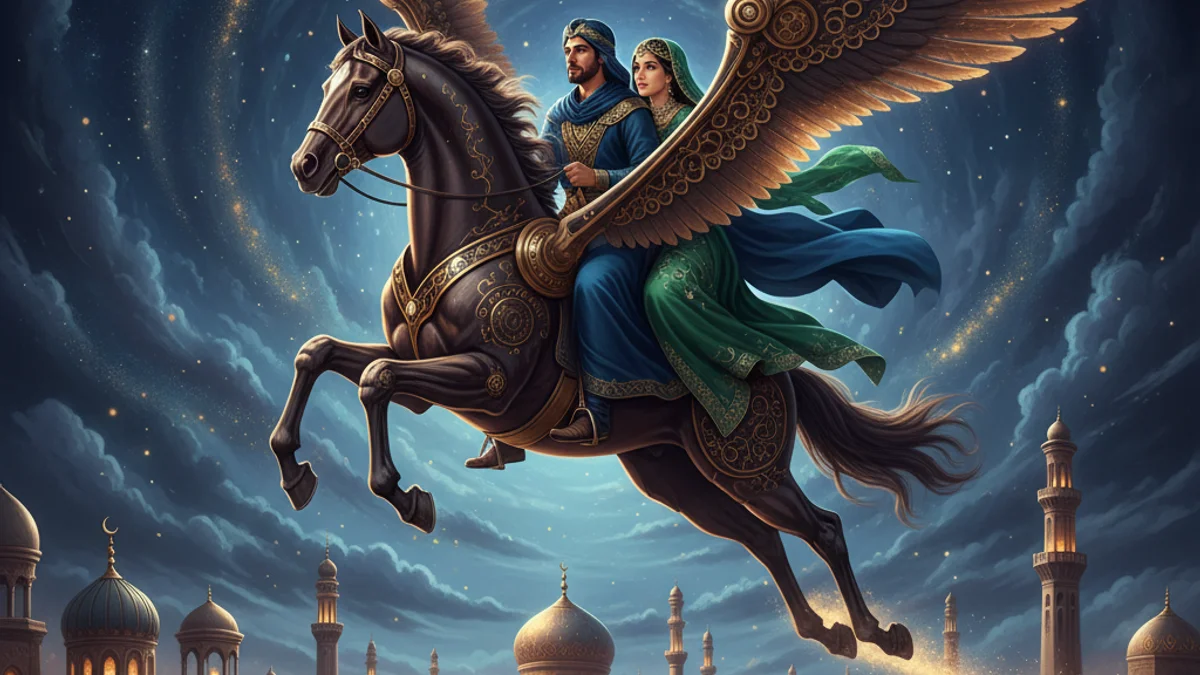
During the festival of Nawrouz, an Indian sage presented King Sabur of Persia with a magnificent mechanical horse carved from dark ebony. The sage claimed the horse could fly wherever its rider desired. The king’s son, Prince Kamar al-Akmar, leaped upon the horse and turned a hidden peg, only to be whisked high into the clouds. He traveled for days until he landed upon the roof of a palace in Sana'a, Yemen. There, he met a princess of peerless beauty and the two fell instantly in love. After staying with her in secret, the Prince convinced her to fly back to Persia with him. However, upon their arrival, the vengeful sage kidnapped the princess and fled to the kingdom of Roum. The Prince spent months searching for her, eventually discovering her held captive by a King who believed she was mad. Disguised as a physician, the Prince reached the princess and tricked the King into bringing the ebony horse out for a 'healing ritual.' As soon as they were both mounted, the Prince turned the peg, and the ebony horse carried them safely back to Persia where they lived in eternal happiness.
Wit and perseverance are the keys to overcoming betrayal and reclaiming one's destiny.
Questions about this story
What is the moral of The Ebony Horse?
The moral is that true love and cleverness can overcome even the most complex mechanical traps and malicious deceits. It teaches that one must be resourceful and persistent when facing adversity.
Who invented the ebony horse in the story?
The horse was created by a cunning Indian sage who presented it to the King of Persia as a gift for the festival of Nawrouz. He hoped to trade the invention for the hand of the King's daughter.
How does the ebony horse fly?
The horse is a mechanical marvel operated by two hidden pegs. Turning one peg causes the horse to ascend into the sky, while turning another causes it to descend and land.
Is The Ebony Horse a real Arabian Nights story?
Yes, it is one of the original tales found in the 'One Thousand and One Nights' collection, often cited as an early precursor to science fiction. It combines elements of fantasy with mechanical ingenuity.
Advertisement

Good night.
