
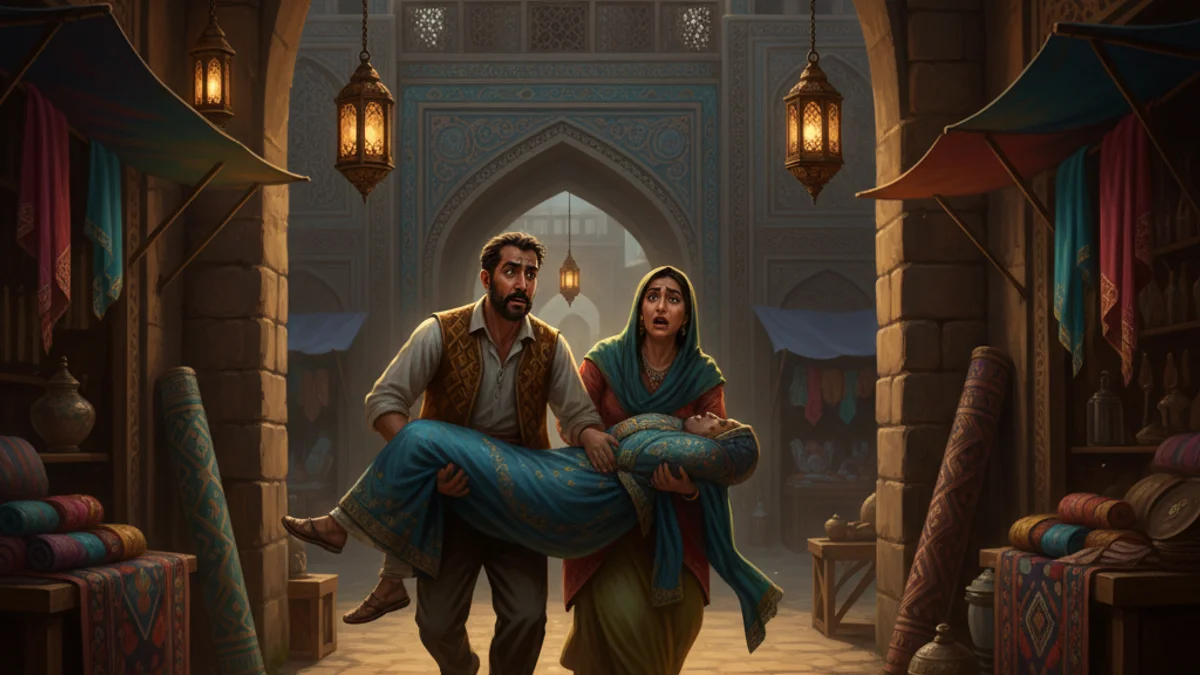
In the city of Basra, a humble tailor and his wife invited a jovial hunchback to dine with them. During the meal, the hunchback choked on a large fishbone and fell still. Panicked and fearing they would be accused of murder, the tailor and his wife carried the body to the house of a Jewish physician, leaving it on the stairs. The physician, rushing down in the dark, accidentally kicked the body, causing it to tumble. Believing he had killed a patient, the physician passed the body to a sultan's steward, who in turn thought he had struck a thief. This chain of mishaps continued until the body was found by a Christian merchant. Eventually, the group was brought before the King of China to face execution. To save their lives, each man told a marvelous tale to amuse the King. The tailor shared the story of a young man and a meddlesome, talkative barber. The King was so entertained by the absurdity of the events and the tailor's wit that he pardoned the entire group, realizing that fate often weaves more complex patterns than any man can plan.
The truth has a way of surfacing despite our attempts to hide it, but wit and storytelling can often bridge the gap between justice and mercy.
Questions about this story
What is the moral of The Story of the Tailor?
The moral highlights that panic often leads to further complications, and that honesty is better than shifting blame. It also suggests that humor and storytelling can be powerful tools for redemption.
How did the hunchback die in the story?
The hunchback initially appeared to die after choking on a fishbone during a dinner hosted by the tailor and his wife. This event set off a chain reaction of people trying to hide the body.
Who finally saved the tailor and his companions?
The King of China pardoned them all after being entertained by the tailor's story about a meddlesome barber. The King found the series of coincidences and the story itself more valuable than an execution.
Is The Story of the Tailor part of the 1001 Nights?
Yes, it is part of the 'Hunchback's Tale' cycle within the One Thousand and One Nights. It serves as a frame story containing several other smaller narratives told by the characters.
Advertisement
Good night.
