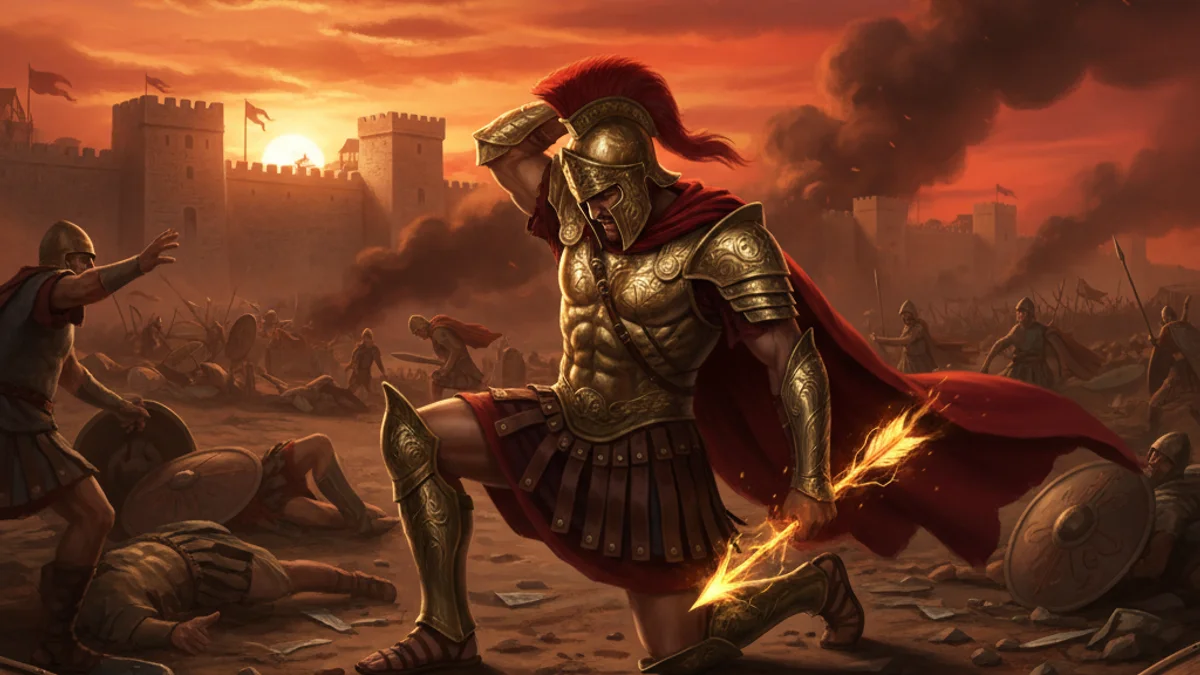
Achilles was the greatest warrior of the Trojan War, a man whose name struck terror into the hearts of his enemies. Dipped in the River Styx by his mother, Thetis, his body was impenetrable to any blade—except for the heel by which she held him. During the final days of the siege of Troy, Achilles fought with unmatched fury, driving the Trojans back to their gates. However, the god Apollo, seeking to humble the arrogant hero, guided the hand of the Trojan prince Paris. From the city walls, Paris loosed a poisoned arrow. Guided by divine will, the shaft struck Achilles squarely in his one vulnerable spot: his heel. The demi-god fell, his lifeblood spilling onto the dusty plains of Troy. Even the mightiest must eventually succumb to the inescapable reach of fate.
Every individual, no matter how powerful or seemingly invincible, possesses a fatal weakness and must eventually face their mortality.
Advertisement
Questions about this story
What is the moral of The Death of Achilles?
The story teaches that every person has a vulnerability, regardless of their strength. It serves as a reminder that pride and physical power cannot shield one from destiny or hidden flaws.
Who killed Achilles in Greek mythology?
Achilles was killed by the Trojan prince Paris. However, Paris was only able to succeed because the god Apollo intervened and guided the arrow to Achilles' only vulnerable spot.
Why was Achilles' heel his only weakness?
His mother, the nymph Thetis, dipped him in the River Styx to grant him invulnerability. Because she held him by his heel, that specific spot never touched the water and remained mortal.
Does the death of Achilles happen in Homer's Iliad?
No, the Iliad ends with the funeral of Hector and does not include the death of Achilles. His demise is detailed in other works of the Epic Cycle and later Greek tragedies.
Advertisement