
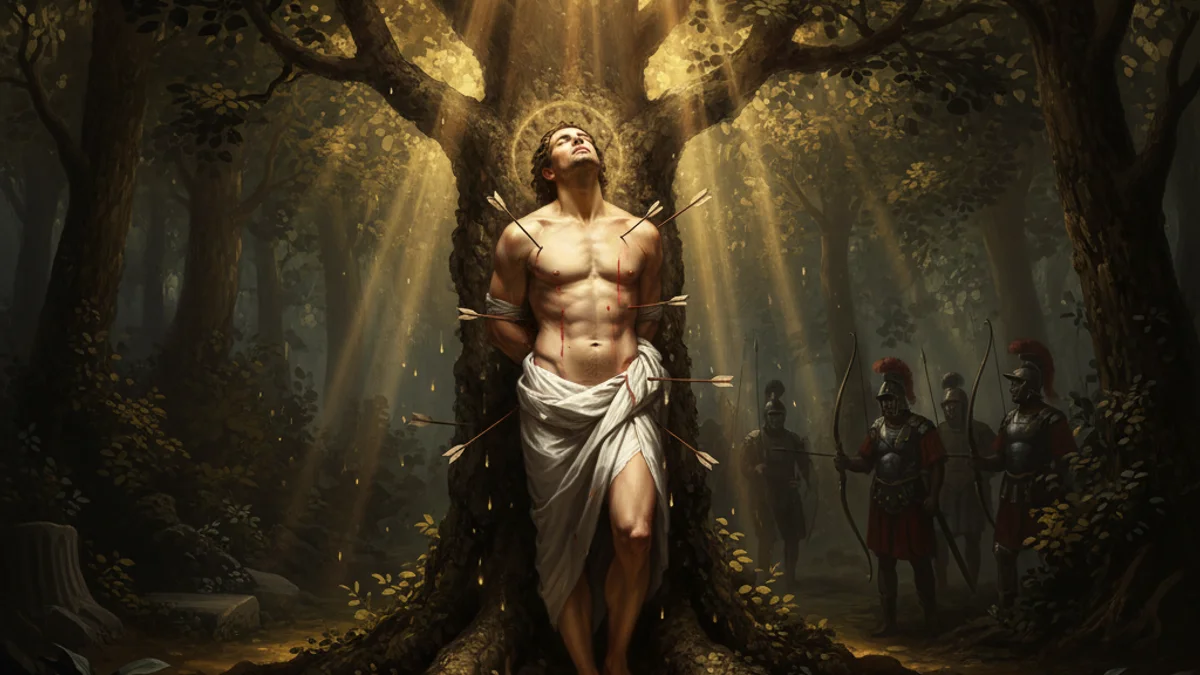
Sebastian was a high-ranking officer in the Roman Praetorian Guard under Emperor Diocletian. Though he wore the uniform of Rome, his heart belonged to Christ. He used his position to secretly comfort Christian prisoners, encouraging them to remain steadfast in their faith. Eventually, his secret was betrayed. Furious at the perceived treason, Diocletian ordered Sebastian to be tied to a stake and shot to death by Mauretanian archers. He was left for dead, his body bristling with arrows. However, when a pious widow named Irene came to retrieve his body, she found him miraculously alive. She nursed him back to health in secret. Once recovered, rather than fleeing, Sebastian stood on a staircase as the Emperor passed and publicly denounced Diocletian’s cruelty toward Christians. Shocked to see the man he thought dead, the Emperor ordered him beaten to death with clubs. This time, Sebastian achieved his final crown of martyrdom, leaving behind a legacy of indestructible faith.
True faith is resilient and grants the courage to stand for one's convictions even in the face of absolute power and death.
Questions about this story
What is the moral of Saint Sebastian's Martyrdom?
The story emphasizes that spiritual conviction is stronger than physical suffering. It teaches that one should remain true to their beliefs even when faced with extreme opposition or personal danger.
How did Saint Sebastian survive the arrows?
While the archers left him for dead, none of the arrows struck a vital organ. His survival is traditionally attributed to a miracle, combined with the dedicated nursing of Saint Irene of Rome.
Why is Saint Sebastian the patron saint of athletes?
He is considered the patron saint of athletes because of his incredible physical endurance and the 'heroic' nature of his survival. His story symbolizes the strength needed to overcome physical adversity.
Who was Emperor Diocletian in the story?
Diocletian was the Roman Emperor who orchestrated some of the most severe persecutions of Christians. In this story, he represents the earthly power that attempts and fails to crush Sebastian's spirit.
Advertisement
Good night.
