
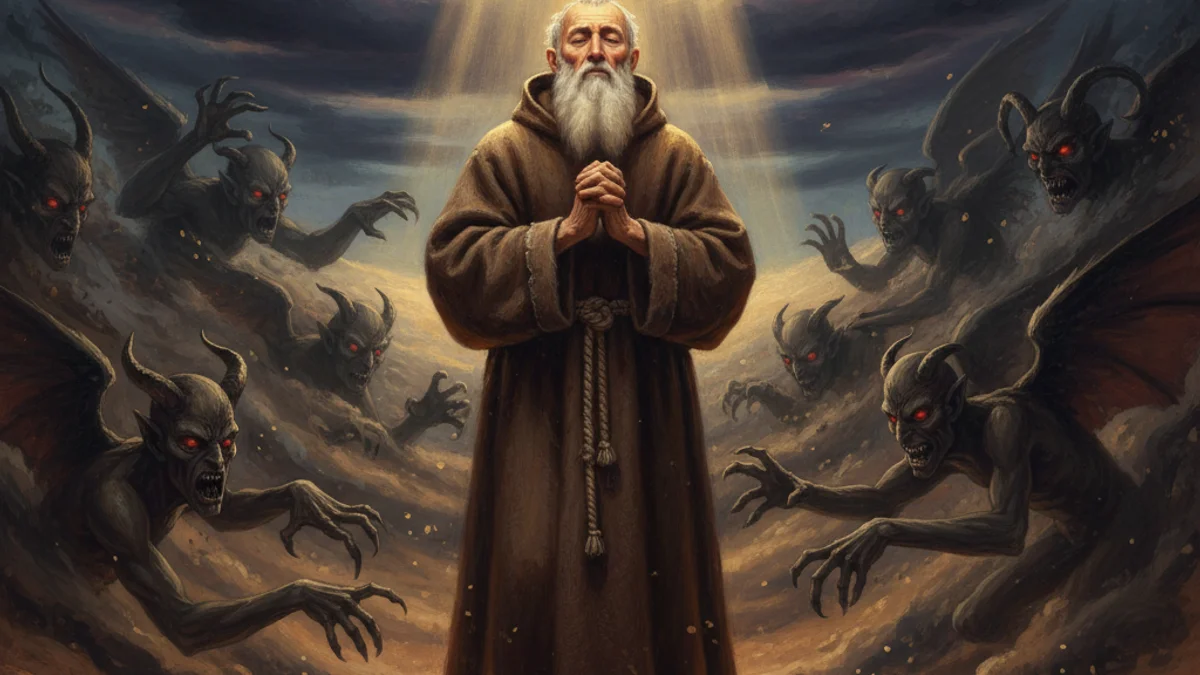
Anthony was a young Egyptian of noble birth and great wealth. One day, hearing the Gospel command to sell all one has and give to the poor, he felt the call deep within his soul. He distributed his inheritance, entrusted his sister to a convent, and retreated to the edge of the desert. Seeking deeper solitude, Anthony moved into an abandoned tomb, where he faced his greatest trials. Legends tell of demons appearing as wild beasts and tempting spirits to shake his resolve. They took the forms of lions, bears, and even seductive visions of gold, yet Anthony remained unmoved. He eventually crossed the Nile to a ruined fort on Mount Pispir, living in total isolation for twenty years. When he finally emerged, he was neither emaciated nor aged by stress, but radiant and balanced. Men flocked to him, seeking his wisdom and healing. Though he sought the silence of the sands, he became the 'Father of Monks,' proving that the greatest battle is the one fought within the human heart.
True spiritual victory is found through inner discipline and the courage to face one's own demons in the silence of solitude.
Questions about this story
What is the moral of Saint Anthony in the Desert?
The story teaches that faith and inner discipline can overcome any external or internal temptation. It emphasizes that solitude is a tool for spiritual growth rather than a source of fear.
Who was Saint Anthony the Great?
Saint Anthony was a 3rd-century Christian from Egypt who is widely considered the father of eremitic monasticism. He famously gave up his great wealth to live a life of prayer in the wilderness.
What were the 'Temptations of Saint Anthony'?
The temptations were a series of spiritual and physical trials where demons supposedly attacked Anthony in various guises, including wild animals and worldly riches. He defeated them through prayer and his refusal to be intimidated.
Why did Saint Anthony go into the desert?
He sought 'ascesis,' a life of self-discipline, to remove all worldly distractions and focus entirely on his relationship with God. He believed the desert was the ultimate testing ground for the soul.
Advertisement
Good night.
