
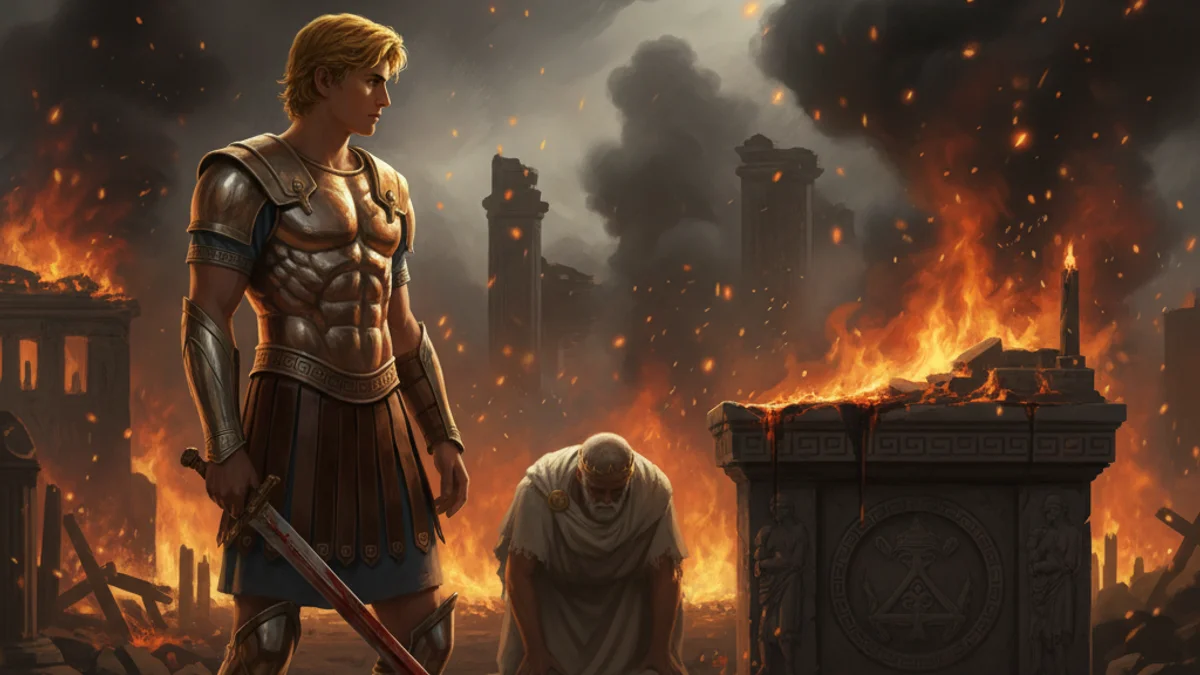
After the death of Achilles, the Greeks learned of a prophecy: Troy would never fall without the presence of Achilles' son. Odysseus traveled to Scyros to fetch the young Neoptolemus, also known as Pyrrhus. Though but a youth, Neoptolemus possessed his father’s golden hair, immense strength, and a frighteningly volatile temper. Upon arriving at Troy, he proved his mettle in battle, inheriting his father's divine armor. He was among the elite warriors hidden within the Trojan Horse. When the Greeks emerged under the cover of night, Neoptolemus led the charge into the royal palace. In a display of ruthless efficiency and cruelty that shocked even his allies, he slaughtered the aged King Priam at the very altar of Zeus and cast the infant Astyanax from the city walls. While he fulfilled the destiny that won the war for the Achaeans, his brutality during the sack of Troy left a dark stain on his legacy, proving that while he inherited his father's skill, he lacked his father's occasional capacity for mercy.
Victory achieved through excessive cruelty often overshadows the glory of the triumph, showing that legacy is defined by character as much as conquest.
Questions about this story
What is the moral of Neoptolemus at Troy?
The story highlights that being a great warrior does not necessarily make one a hero. It teaches that the pursuit of victory at any cost, including the abandonment of mercy and piety, leads to a tarnished reputation.
Who was Neoptolemus' father?
Neoptolemus was the son of the legendary hero Achilles and the princess Deidamia. He was brought to the Trojan War because a prophecy stated that his presence was required for the Greeks to succeed.
Was Neoptolemus in the Trojan Horse?
Yes, Neoptolemus was one of the chosen warriors who hid inside the wooden horse. He was known for being fearless and was among the first to leap out and begin the final assault on the city.
How did Neoptolemus treat King Priam?
Unlike his father Achilles, who showed Priam mercy by returning Hector's body, Neoptolemus was ruthless. He dragged the elderly king from the altar of Zeus and killed him without hesitation.
Advertisement

Good night.
