
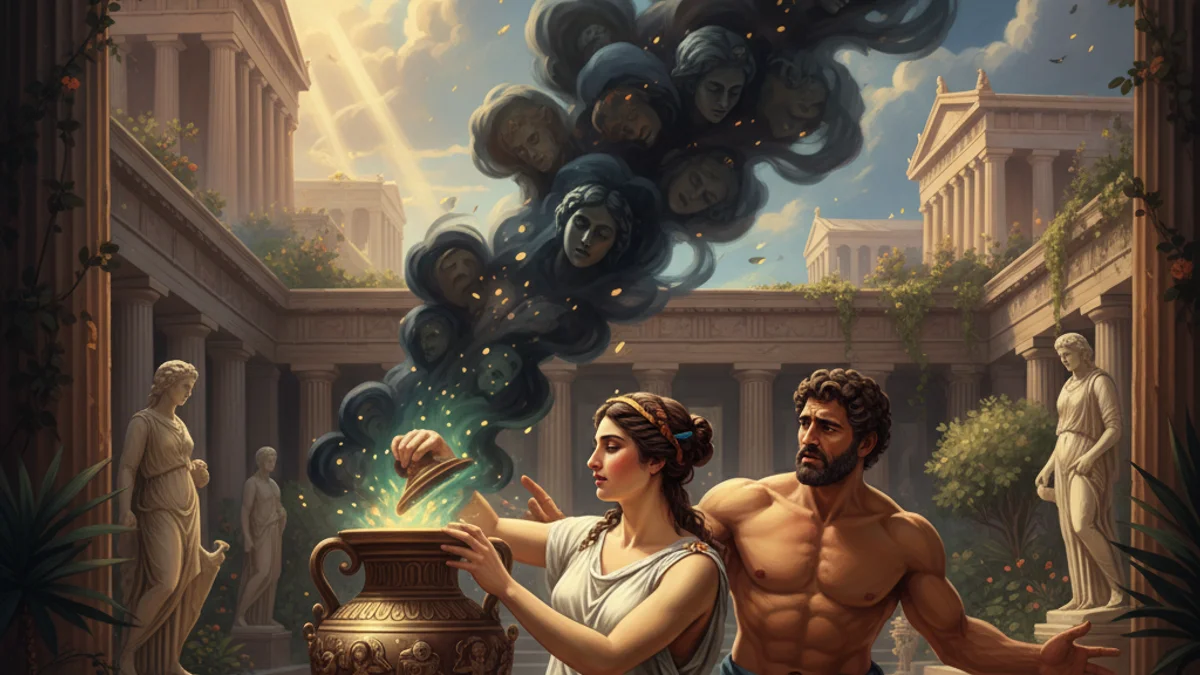
After Prometheus stole fire from Olympus, Zeus plotted a subtle revenge. He commanded Hephaestus to fashion the first woman, Pandora, and endowed her with gifts from every god. Despite warnings from his brother Prometheus to never accept a gift from Zeus, the Titan Epimetheus—whose name means 'Afterthought'—was captivated by Pandora's beauty and took her as his wife. Pandora brought with her a mysterious, sealed jar, a wedding gift she was strictly forbidden to open. For a time, they lived in harmony, but Pandora’s divinely implanted curiosity eventually overcame her. She lifted the lid, and instantly, a swarm of miseries—sickness, toil, and strife—escaped to plague humanity forever. Terrified, she slammed the lid shut, but it was too late. Only one thing remained trapped at the very bottom of the jar: Hope, the singular comfort meant to sustain mankind through the hardships she had unleashed.
Unchecked curiosity and the failure to heed warnings can bring unforeseen suffering, yet hope remains as a constant source of strength.
Questions about this story
What is the moral of Epimetheus and Pandora?
The story warns that actions taken without foresight can lead to irreversible consequences. However, it also teaches that no matter how much suffering exists, hope is always available to help humanity endure.
Why did Zeus create Pandora?
Zeus created Pandora as a form of 'beautiful evil' to punish mankind and the Titans. It was his retribution for Prometheus stealing the secret of fire from the gods.
Was it a box or a jar that Pandora opened?
In the original Greek texts, it was a 'pithos,' which is a large storage jar. The idea of it being a 'box' originated from a 16th-century mistranslation by the scholar Erasmus of Rotterdam.
What does the name Epimetheus mean?
Epimetheus means 'Afterthought' in Greek, reflecting his tendency to act before thinking. This contrasts with his brother Prometheus, whose name means 'Forethought.'
Advertisement

Good night.
