
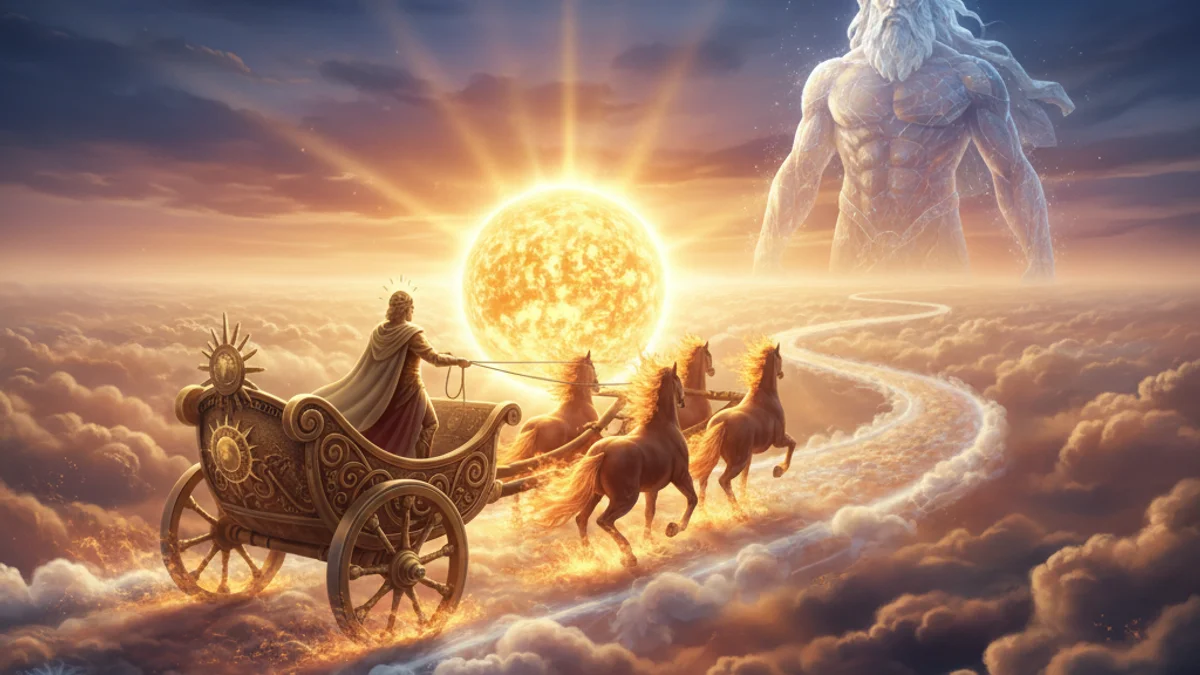
In the primordial age of the cosmos, the Titan Hyperion stood as the 'God of Observation,' the pillar of the east who first understood the cycles of the stars and seasons. He was the very essence of heavenly light. Alongside his consort Theia, he sired three radiant children: Eos the Dawn, Selene the Moon, and Helios the Sun. While Hyperion represented the foundational light of the heavens, it was Helios who inherited the active duty of illuminating the mortal world. Each morning, Hyperion watched from the heights as Helios mounted his golden chariot drawn by four fire-breathing horses. As the father provided the wisdom and the lineage of brilliance, the son executed the daily task of driving the sun across the firmament. Even when the Titans fell to the Olympian gods, Helios was spared his father's fate in Tartarus because his role was essential to life itself. Together, the story of Hyperion and Helios represents the transition from the raw, elemental power of the universe to the structured, daily rhythm of the natural world.
Greatness is often a legacy passed from father to son, where the foundation laid by one generation allows the next to shine brightly for the world.
Questions about this story
What is the moral of Hyperion and Helios?
The moral focuses on the continuity of duty and the transition of power between generations. It teaches that the foundations laid by ancestors enable the current generation to perform their vital roles.
What is the difference between Hyperion and Helios?
Hyperion is the Titan father representing the primordial light of the heavens and the pillar of the East. Helios is his son, the specific personification of the sun who drives the golden chariot across the sky daily.
Who is the mother of Helios?
Helios's mother is the Titaness Theia, who was the goddess of sight and the brilliance of gold, silver, and precious gems. She was both the sister and wife of Hyperion.
What happened to Hyperion after the Titanomachy?
According to most myths, Hyperion was imprisoned in Tartarus with his brothers after being defeated by Zeus. However, some versions suggest he was eventually released by Zeus to reside in the Isles of the Blessed.
Advertisement

Good night.
