
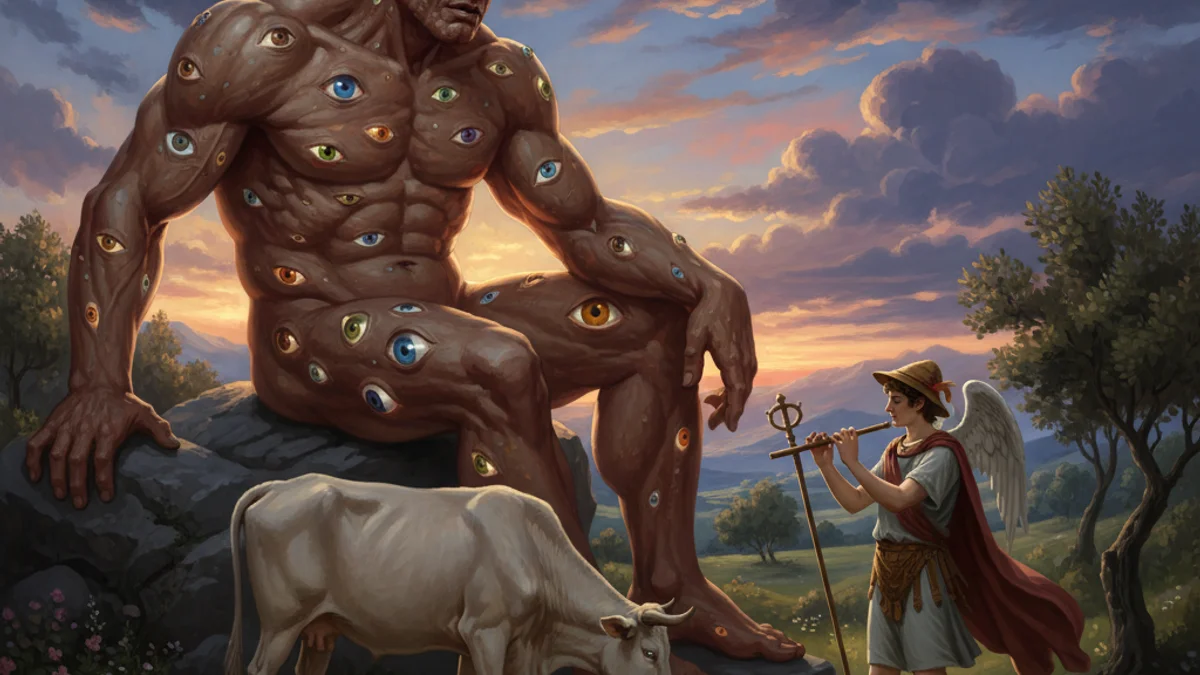
Hera, the queen of the gods, was deeply suspicious of Zeus's affection for the nymph Io. To hide his lover from Hera's wrath, Zeus transformed Io into a beautiful white heifer. Seeing through the deception, Hera demanded the cow as a gift and appointed Argus Panoptes, a giant with a hundred eyes, to be her jailer. Argus was the perfect sentinel; because his eyes slept in shifts, he was always partially awake and ever-watchful. Distressed by Io’s misery, Zeus sent the messenger god Hermes to rescue her. Disguised as a simple shepherd, Hermes played his syrinx pipes and told long, drowsy tales until every one of Argus’s hundred eyes finally closed in slumber. Once the giant was fully asleep, Hermes struck him down. To honor her fallen servant, Hera took the hundred eyes of Argus and placed them upon the tail of her favorite bird, the peacock, where they remain to this day.
Vigilance and strength can still be overcome by cleverness, art, and the power of persuasion.
Questions about this story
What is the moral of Argus the Hundred-Eyed?
The story suggests that vigilance alone cannot withstand cunning and the persuasive power of art. It also reflects how innocence is often caught in the crossfire of divine conflicts.
How many eyes did Argus have?
Argus Panoptes was known as the 'All-Seeing' because he possessed one hundred eyes scattered across his body. This allowed him to keep some eyes open while others slept, making him a perfect guardian.
Why did Hera put eyes on the peacock?
After Hermes killed Argus, Hera wanted to memorialize her faithful watchman. She took his hundred eyes and set them into the plumage of her sacred bird, the peacock, explaining the 'eye' patterns on their feathers.
Who killed Argus in Greek mythology?
Argus was killed by Hermes, the messenger god, on the orders of Zeus. Hermes used music and storytelling to lull all of Argus's eyes to sleep before slaying him.
Advertisement

Good night.
