
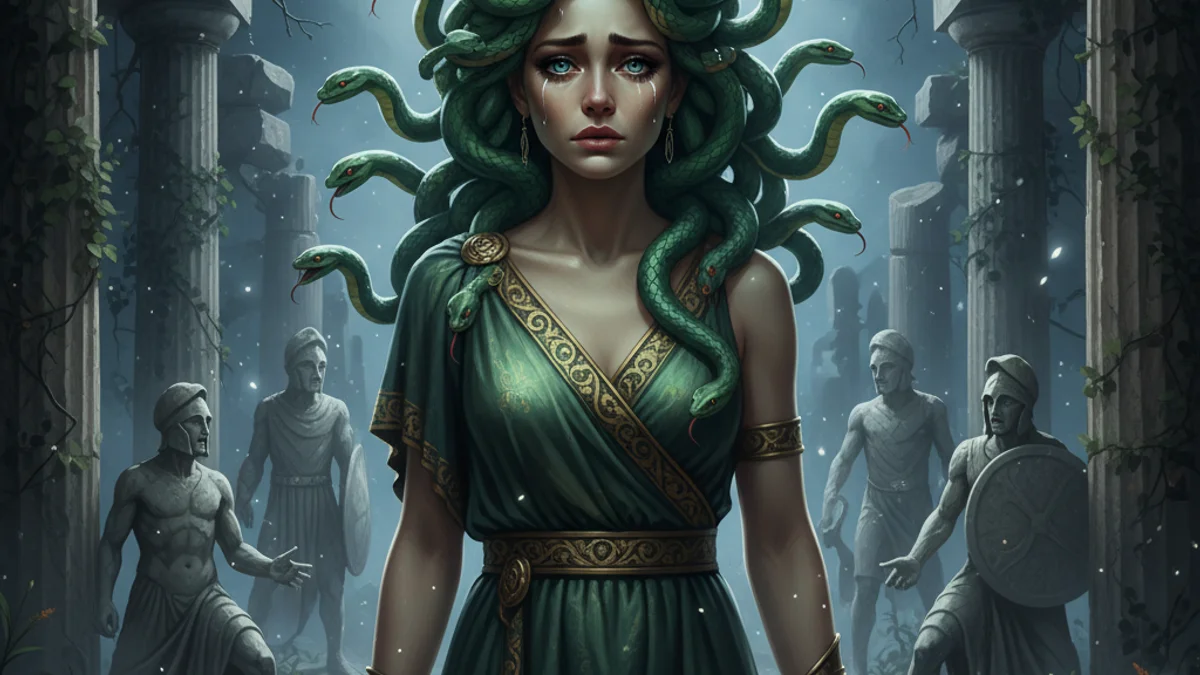
Once a priestess of stunning beauty in Athena's temple, Medusa’s life was shattered when she caught the eye of the sea god Poseidon. Enraged by the violation of her sacred space, the goddess Athena transformed Medusa into a hideous monster. Her flowing golden hair became a mass of writhing, venomous vipers, and her eyes were cursed to turn any living creature who looked upon her into cold stone. Banished to a remote island, Medusa lived in lonely terror until the hero Perseus was dispatched to claim her head as a trophy. Guided by Hermes and Athena, Perseus used a polished bronze shield to view only her reflection, avoiding her lethal gaze. With one swift strike of a harpe sword, he ended her misery. From her blood, the winged horse Pegasus and the giant Chrysaor were born, and her head was placed upon Athena’s aegis as a symbol of protection.
Beauty is fleeting and often subject to the whims of fate, yet even in destruction, new life and strength can be born.
Questions about this story
What is the moral of Medusa the Gorgon?
The story serves as a warning about the volatile nature of the gods and the idea that tragedy can lead to unexpected transformation. It also suggests that even the most terrifying monsters may have a history of suffering.
Why did Athena turn Medusa into a Gorgon?
In most versions of the myth, Athena cursed Medusa after the maiden was found with Poseidon in Athena's temple. The transformation was intended as a punishment for the perceived desecration of the sacred space.
How did Perseus defeat Medusa without looking at her?
Perseus used a highly polished bronze shield given to him by Athena as a mirror. By watching her reflection rather than looking at her directly, he was able to avoid being turned to stone.
Who were Medusa's sisters?
Medusa had two sisters, Stheno and Euryale. Unlike Medusa, who was born mortal, her sisters were immortal Gorgons who possessed similar terrifying features.
Advertisement
Good night.
