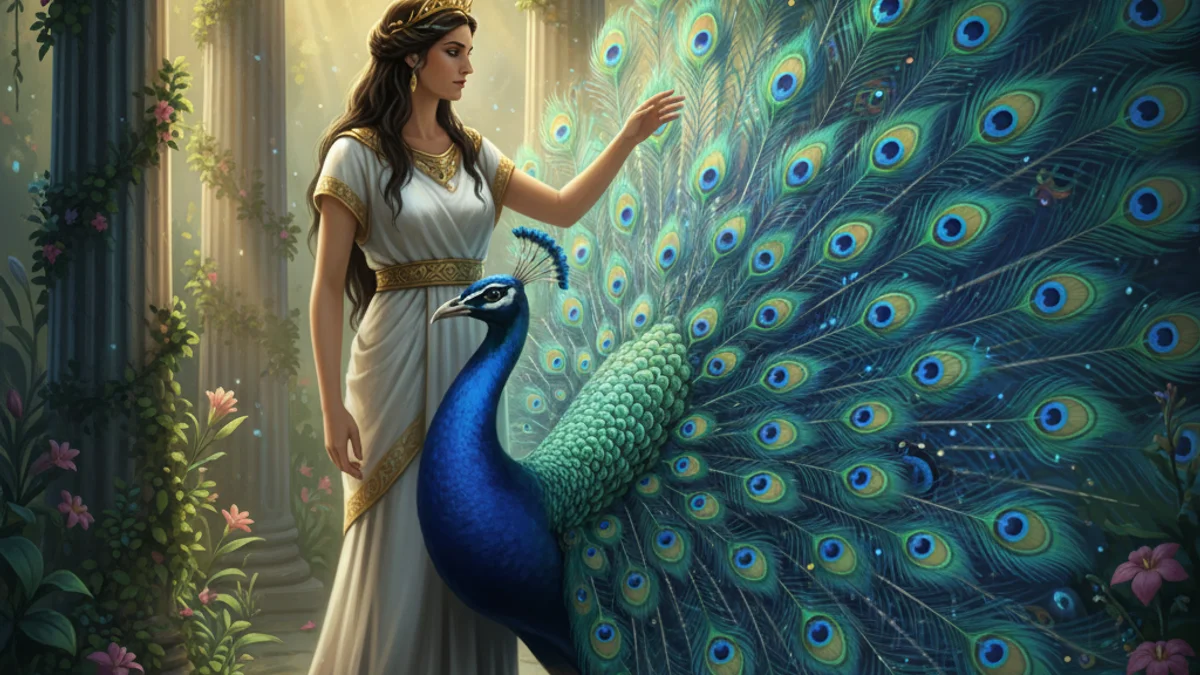
When Zeus fell in love with the mortal Io, he transformed her into a white heifer to hide her from his jealous wife, Hera. Suspicious of the beautiful animal, Hera claimed the cow as a gift and appointed Argus Panoptes, a giant with a hundred eyes, to be her guard. Because Argus never closed all his eyes at once, he was the perfect watchman. Distressed by Io’s imprisonment, Zeus sent Hermes to rescue her. Hermes, disguised as a shepherd, played his reed pipes and told monotonous stories until every one of the giant's hundred eyes finally succumbed to sleep. Once Argus was slumbering, Hermes struck him down. To honor her fallen servant, a grieving Hera gathered the eyes of Argus and set them into the tail feathers of her sacred bird, the peacock, so his eternal watchfulness would never be forgotten.
Loyalty is often rewarded with remembrance, and even the most vigilant watchman can be defeated by cunning and patience.
Questions about this story
What is the moral of Hera and the Peacock?
The story teaches that vigilance has its limits and can be overcome by cleverness. It also shows how loyalty can be immortalized through art and nature.
Who was Argus Panoptes in Greek mythology?
Argus was a giant known as 'Panoptes' or 'all-seeing' because he had a hundred eyes. He was a devoted servant to Hera and a legendary guardian who never fully slept.
Why did Hera put eyes on the peacock?
Hera placed the eyes on the peacock as a tribute to her loyal watchman, Argus, after he was killed by Hermes. This transformed her sacred bird into a symbol of her power and oversight.
How did Hermes defeat the hundred-eyed giant?
Hermes used the power of music and storytelling to lull Argus to sleep. By playing a flute and speaking in a soothing drone, he eventually caused all one hundred eyes to close at the same time.
Advertisement


Good night.
