
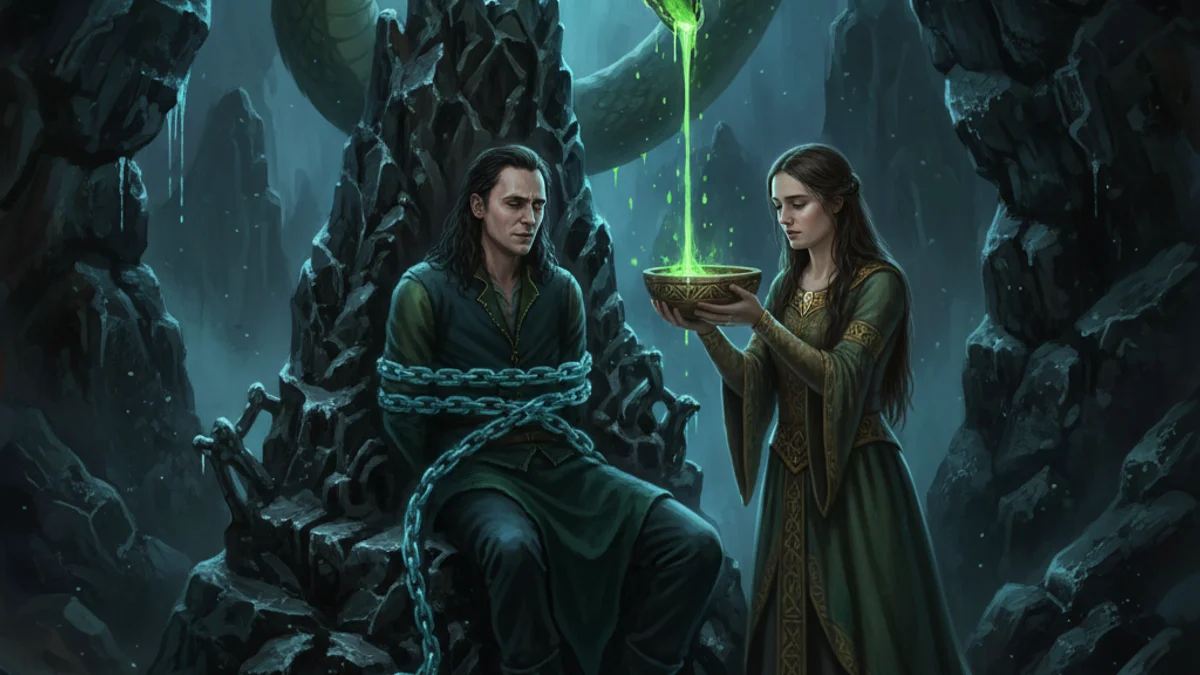
After the death of the beloved god Baldur, the trickster Loki fled to a mountain hideout, transforming himself into a salmon to evade capture. However, the Aesir caught him in the waterfalls of Franang’s Falls. They dragged him to a dark cave and brought his sons, Narfi and Vali. In a cruel twist of fate, Vali was turned into a wolf and tore Narfi apart. The gods then used Narfi’s cold entrails, which turned into unbreakable iron chains, to bind Loki to three jagged rocks. Skadi, seeking vengeance for her father, fastened a venomous serpent above Loki’s head, so its burning poison would drip onto his face. His loyal wife, Sigyn, stayed by his side, holding a bowl to catch the venom. But whenever she had to empty the vessel, the poison struck Loki, causing him to writhe in such agony that the entire earth shook. There he remains bound, awaiting the final battle of Ragnarok.
Betrayal and malice eventually carry a price that no amount of cleverness can evade, leading to isolation and suffering.
Questions about this story
What is the moral of Loki's Punishment?
The story serves as a warning that one's actions have inescapable consequences. It emphasizes that even the most cunning individuals cannot outrun the justice of those they have deeply wronged.
Why was Loki punished so severely?
Loki orchestrated the death of Baldur, the most beloved of all gods, and then prevented his return from Hel. His subsequent insults to the gods at a feast finalized their decision to imprison him.
How did the Aesir catch Loki?
Loki hid in a house with four doors to watch for the gods, often transforming into a salmon. The Aesir used a net—a device Loki himself had invented—to trap him in a river.
Who is Sigyn in Norse mythology?
Sigyn is Loki's wife, known for her extraordinary loyalty and devotion. Despite his crimes, she remains with him in the cave to shield him from the serpent's venom for as long as she can.
Advertisement
Good night.
