
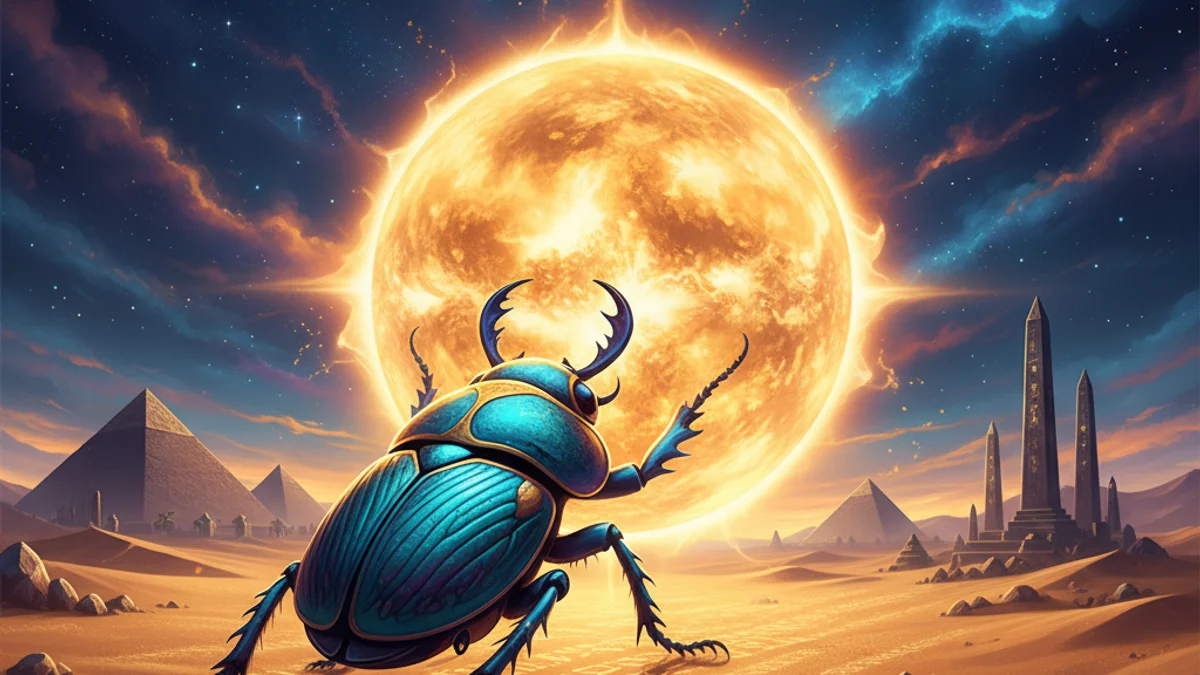
In the beginning, there was only the silent, dark waters of Nun. From this primordial void, Khepri, the god of the morning sun, willed himself into existence. He took the form of a great scarab beetle, a creature known to the ancients for its tireless work in the sands. Khepri did not merely exist; he acted. He rolled the golden orb of the sun out of the darkness and across the eastern horizon. Just as the scarab beetle pushes its ball of earth, Khepri moved the sun through the heavens, marking the birth of time and the triumph of light over chaos. Every dawn is a repetition of this first creation, where Khepri transforms the potential of the night into the reality of a new day, ensuring that life continues to cycle through rebirth and renewal.
Great transformations often begin with steady, humble persistence, and every ending is merely the seed of a new beginning.
Advertisement
Questions about this story
What is the moral of Khepri and the Scarab?
The story teaches that life is a continuous cycle of renewal and that even the smallest actions contribute to the cosmic order. It emphasizes that every new day is an opportunity for rebirth and self-creation.
Who is Khepri in Egyptian mythology?
Khepri is the solar deity representing the rising morning sun and the concept of becoming. He is often depicted as a scarab beetle or a man with a beetle for a head.
Why did the Egyptians associate the scarab with the sun?
Ancient Egyptians observed dung beetles rolling balls of waste across the sand and disappearing into the earth, only for new life to emerge. They likened this to the sun being rolled across the sky and reborn each morning.
How does Khepri relate to Ra and Atum?
They are aspects of the same sun god: Khepri is the sun at dawn, Ra is the sun at high noon, and Atum is the setting sun in the evening. Together, they represent the complete solar cycle.
Advertisement
