
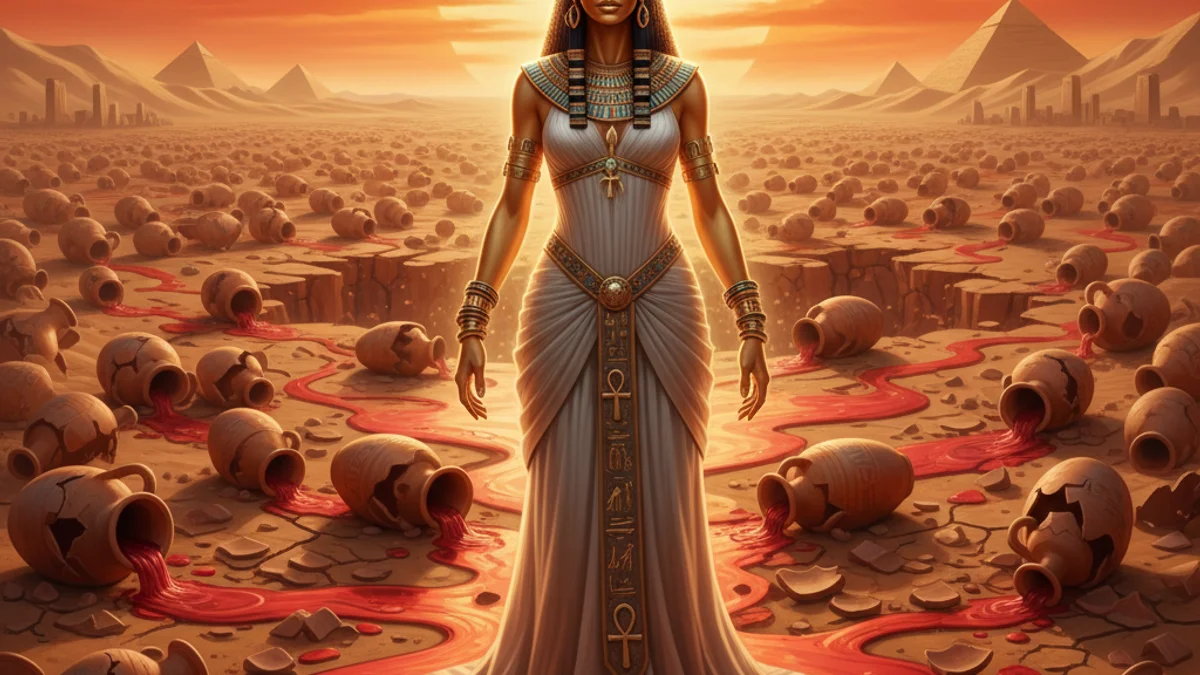
In the early days of the world, when the sun god Ra grew old, mankind began to plot against his divine rule. Enraged by their insolence, Ra dispatched his eye in the form of the goddess Hathor to punish the rebels. Descending as the terrifying lioness Sekhmet, she began a slaughter so fierce that the Nile ran red with blood. Her bloodlust became an all-consuming fire that threatened to extinguish all human life. Realizing that his vengeance had gone too far, Ra sought a way to soothe her. He ordered his servants to brew seven thousand jars of beer, mixing them with red ochre to mimic the color of blood. They spread the mixture over the fields where the goddess intended to hunt. When Sekhmet arrived, she saw the red lake and drank greedily. Overcome by the intoxicating brew, she fell into a deep slumber. When she finally awoke, her rage had evaporated, and she was transformed into the gentle, beautiful Hathor. She returned to the heavens as the Golden One, the goddess of love, music, and dance, choosing to nurture humanity rather than destroy it.
True power is found in the transition from destructive anger to creative love and peace.
Questions about this story
What is the moral of Hathor the Golden One?
The story teaches that unchecked rage leads to ruin, whereas wisdom and joy can transform even the most destructive force into a source of beauty. It emphasizes the importance of balance between justice and mercy.
Who is Hathor in Egyptian mythology?
Hathor is one of the most important ancient Egyptian goddesses, representing love, beauty, music, fertility, and the sky. She was often depicted as a woman with cow horns or as a celestial cow.
What is the relationship between Hathor and Sekhmet?
In Egyptian myth, Hathor and Sekhmet are often seen as two sides of the same coin. Sekhmet represents the destructive, fiery heat of the sun, while Hathor represents its life-giving, gentle warmth.
How did Ra trick Hathor to save humanity?
Ra ordered the creation of a vast amount of beer dyed with red ochre to look like blood. When the goddess drank it, she became intoxicated and fell asleep, ending her violent rampage.
Advertisement

Good night.
