
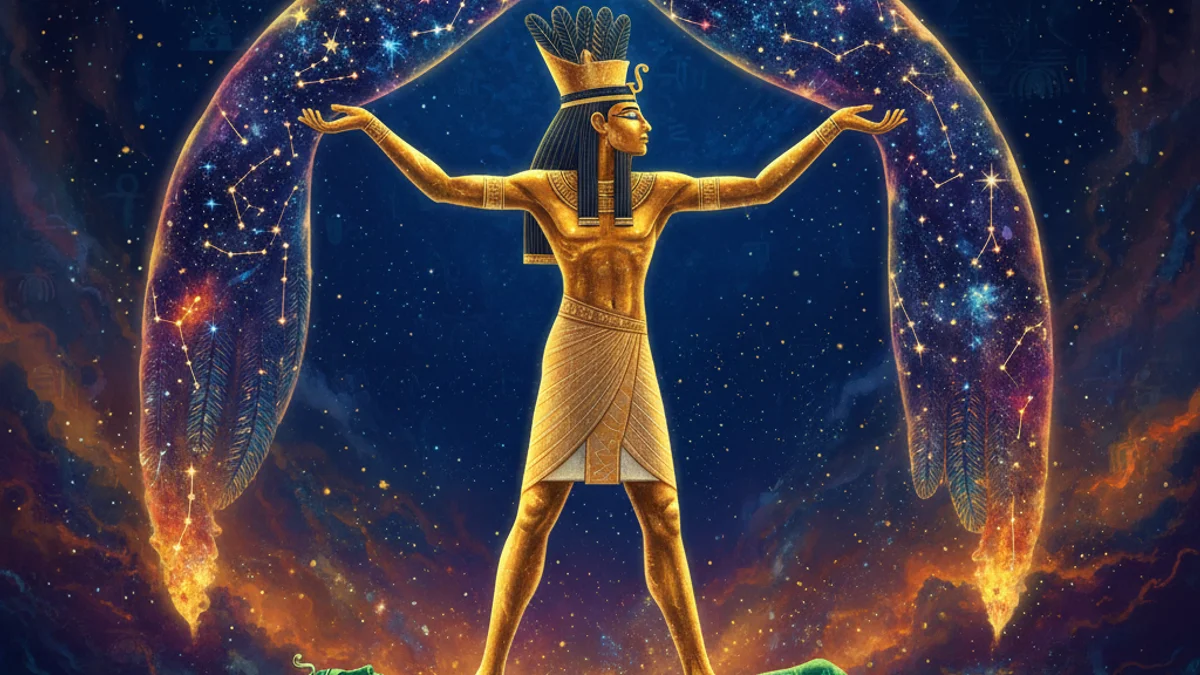
In the primordial era, the universe was cramped and dark. Nut, the goddess of the starry sky, and Geb, the god of the earth, were locked in a constant, passionate embrace. Because they were inseparable, there was no room for the sun to rise or for life to breathe. Seeing that chaos reigned, the creator god Atum-Ra commanded Shu, the god of air and wind, to intervene. With immense strength, Shu stepped between the two lovers. He used his powerful arms to lift Nut high above his head, arching her body into a canopy of stars, while his feet pressed Geb down into the foundation of the world. Though the separation broke their hearts—Nut’s tears falling as rain and Geb’s longing shaking the earth—the space between them filled with the atmosphere. This act established Ma'at, the divine order, allowing the sun boat of Ra to sail across the heavens and giving humanity the air and space needed to flourish.
Order and growth often require the establishment of boundaries and the sacrifice of personal desires for the greater good.
Advertisement
Questions about this story
What is the moral of Shu Holds Up the Sky?
The story teaches that order and the separation of elements are necessary for life to exist. It highlights the importance of divine duty and sacrifice in maintaining the balance of the universe.
Who are Nut and Geb in this story?
Nut is the goddess of the sky and Geb is the god of the earth. They were siblings and lovers whose separation by Shu created the physical world as we know it.
Why did Shu have to separate the sky and earth?
Shu separated them because their constant embrace left no room for the sun to rise or for living creatures to exist. His intervention created the atmosphere and the space required for life.
What does Shu represent in Egyptian mythology?
Shu is the god of air, wind, and the atmosphere. He represents the life-giving breath and the pillar that prevents the heavens from collapsing onto the earth.
Advertisement
