
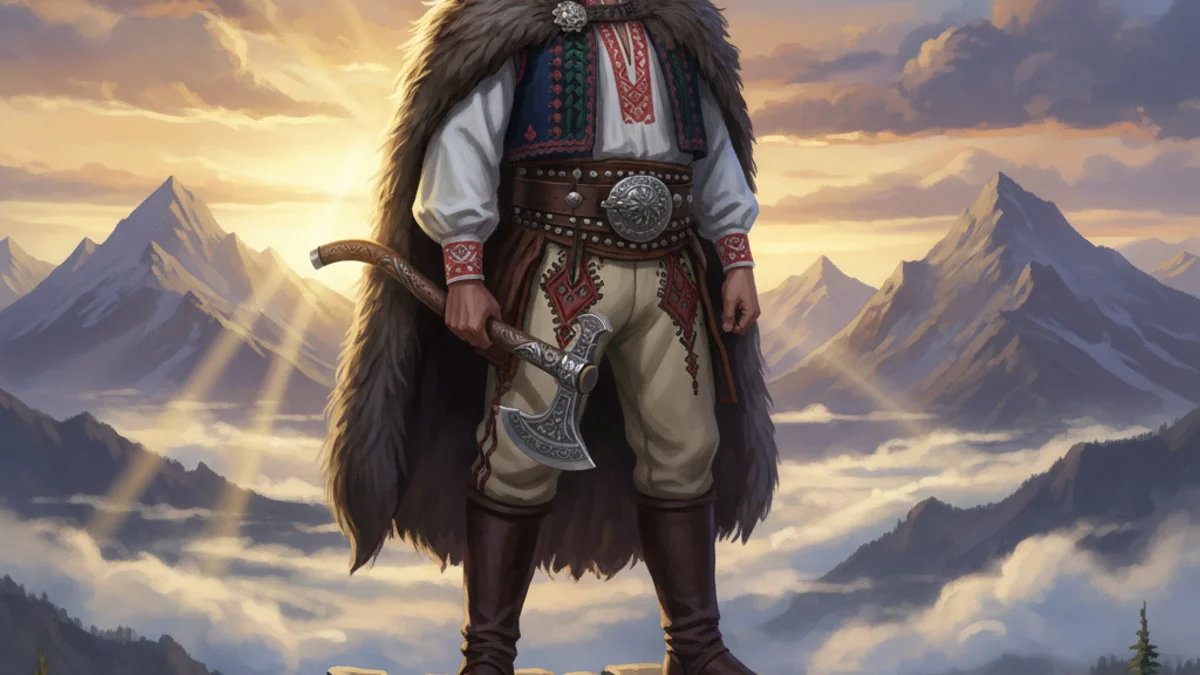
Born in the village of Terchová, Juraj Jánošík was a young man of great strength and spirit who lived during a time of harsh feudal oppression. Originally a divinity student and then a soldier, his life changed forever when he witnessed the brutal treatment of his parents by local lords. Turning his back on the law, he retreated to the jagged peaks of the Tatra Mountains and joined a band of forest outlaws. Known for his charisma and sense of justice, Jánošík soon became their captain. Unlike common thieves, his band followed a strict code: they never killed unless in self-defense and focused their raids on wealthy aristocrats and corrupt tax collectors. They distributed their loot—gold, silk, and grain—among the starving peasants of the valley. Legends grew that Jánošík possessed a magical belt and a valaška axe that granted him superhuman strength and protection. However, in 1713, he was betrayed at an inn. Some say an old woman scattered peas on the floor, causing the hero to slip as the guards rushed in. Even under brutal torture, he refused to betray his men. He was sentenced to death by being hung on a hook through his ribs, facing his end with the same defiance that made him a legend.
True heroism is found in the courage to stand against systemic injustice and sacrifice oneself for the welfare of the oppressed.
Advertisement
Questions about this story
What is the moral of Juraj Janosik the Slovak Robin Hood?
The story teaches that standing up for justice and the common good is a noble pursuit, even in the face of certain doom. It emphasizes that the spirit of liberty and resistance against tyranny lives on long after the hero is gone.
Was Juraj Jánošík a real historical figure?
Yes, Jánošík was a real person born in 1688. Historical records from his 1713 trial in Liptovský Mikuláš still exist, though his life has been heavily mythologized over the centuries into a folk hero legend.
How did Jánošík help the poor?
According to legend and folk songs, he and his band of 'mountain boys' robbed wealthy merchants and noblemen traveling through mountain passes. They redistributed the stolen riches to impoverished villagers to help them pay taxes and buy food.
What are the magical elements in his legend?
Folk tales claim Jánošík possessed a magical belt given to him by wood nymphs that made him bulletproof and doubled his strength. His 'valaška' or shepherd's axe was also said to have enchanted properties that allowed him to fight dozens of men at once.
Advertisement

