
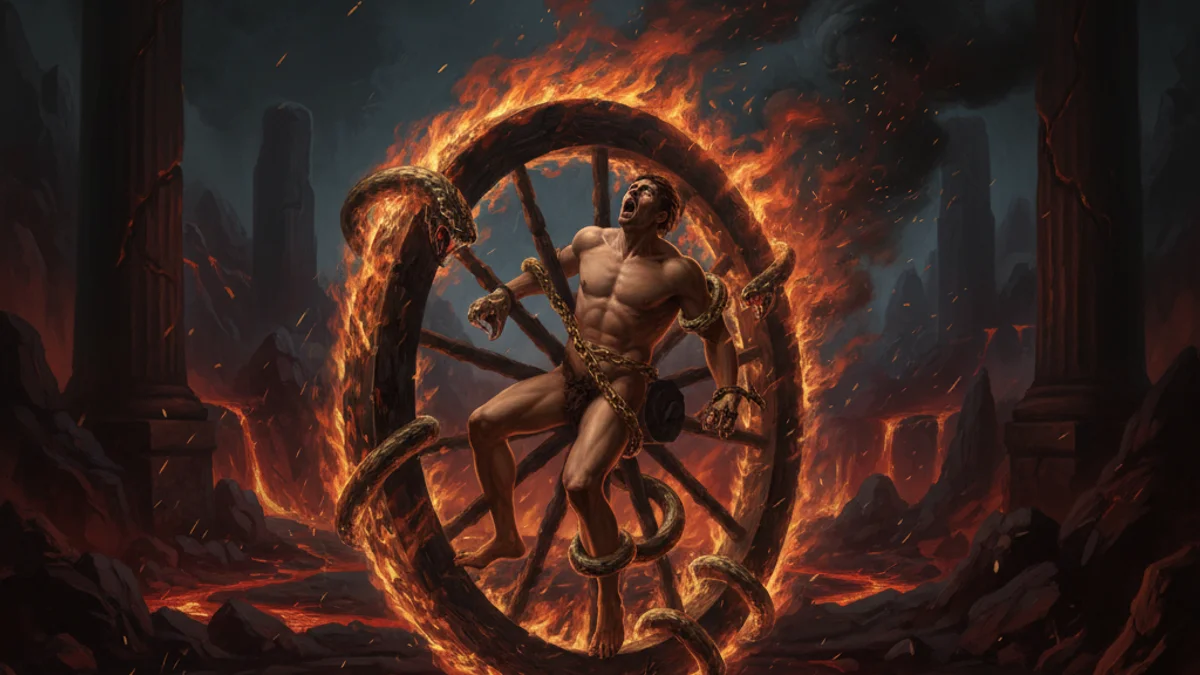
Ixion, King of the Lapiths, was a man of dark character. After murdering his father-in-law to avoid paying a bride price, he became the first mortal to commit kin-slaying. No earthly power would purify him, but Zeus, showing unearned mercy, invited Ixion to Olympus to be cleansed. Rather than being grateful, Ixion grew arrogant and attempted to seduce Zeus's wife, Hera. Discerning his intent, Zeus fashioned a cloud, Nephele, into Hera's likeness. Ixion, fooled by the deception, boasted of his conquest. Enraged by this ultimate breach of hospitality and divine disrespect, Zeus ordered Hermes to bind Ixion to a perpetually spinning, winged, fiery wheel. Cast into the deepest pits of Tartarus, Ixion remains there for eternity, his screams echoing as a warning against the twin sins of ingratitude and hubris.
Betraying the trust of those who show you mercy and violating the laws of hospitality leads to inevitable and eternal ruin.
Questions about this story
What is the moral of Ixion on the Wheel?
The story warns against hubris and the betrayal of hospitality. It teaches that showing ingratitude toward those who help you can lead to a cycle of self-inflicted suffering.
Why was Ixion punished by Zeus?
Despite being purified by Zeus for murder, Ixion tried to seduce Zeus's wife, Hera. This gross violation of hospitality and divine order led to his eternal sentence.
What did the cloud Nephele represent?
Zeus created Nephele as a cloud-double of Hera to test Ixion's intentions. When Ixion coupled with the cloud, he proved his guilt and fathered the race of Centaurs.
What was the significance of Ixion being the first kin-slayer?
In Greek culture, murdering a relative was a crime so severe that it required divine purification. Ixion's initial crime set the stage for Zeus's rare act of mercy.
Advertisement

Good night.
