
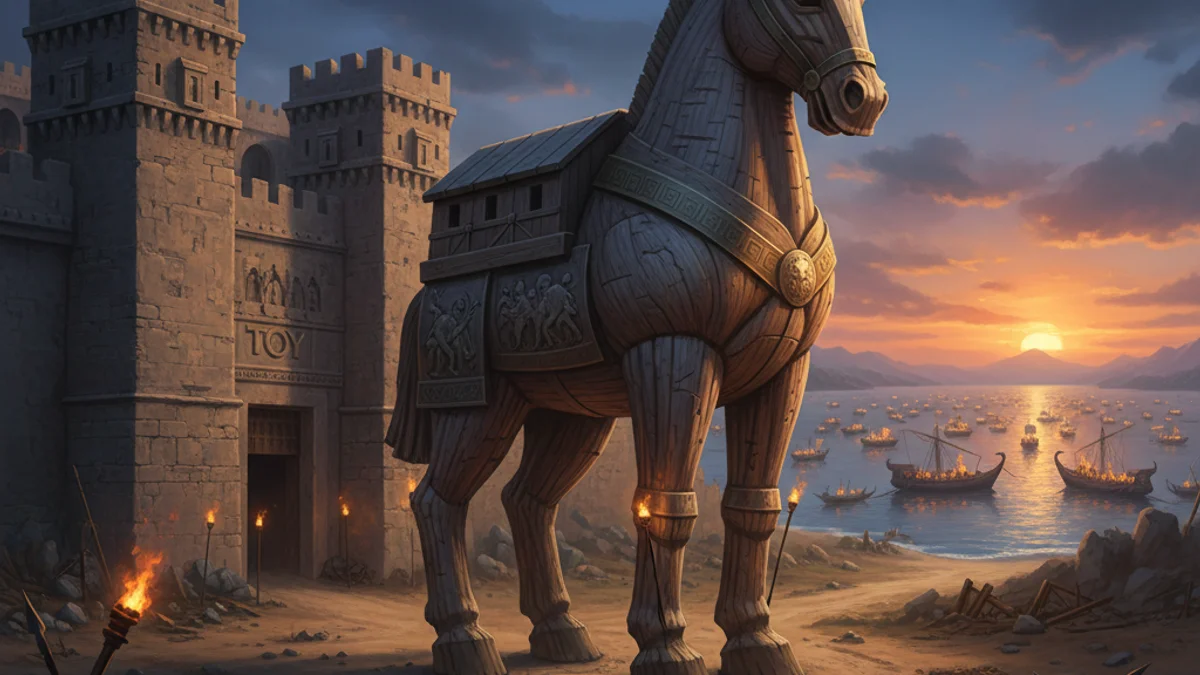
The Trojan War began with a golden apple inscribed 'To the Fairest.' When the Trojan prince Paris judged Aphrodite the winner, she promised him the love of Helen, the most beautiful woman in the world. However, Helen was already married to King Menelaus of Sparta. Paris abducted Helen, prompting a massive Greek coalition led by Agamemnon to sail for Troy. For ten years, the two sides were locked in a bloody stalemate. Legendary heroes emerged: the invincible Greek Achilles and the noble Trojan prince Hector. After the death of Hector and the eventual fall of Achilles, the Greeks devised a cunning plan. They built a massive wooden horse and left it at the gates as a supposed offering to the gods, while their fleet hid nearby. Despite warnings, the Trojans brought the horse inside their walls. At night, Greek soldiers crept out of the hollow belly, opened the city gates, and Troy was sacked, ending the great war in fire and ruin.
Pride and the pursuit of glory often lead to devastating loss, and even the strongest walls cannot protect against clever deception.
Questions about this story
What is the moral of The Trojan War?
The story illustrates that war brings ruin to all sides and that intellectual cunning can succeed where brute force fails. It also warns against the dangers of pride and ignoring wise counsel.
Was the Trojan War a real historical event?
While the myth is legendary, archaeologists have found evidence of a historical city of Troy (Hisarlik) that was destroyed around 1200 BCE. Most scholars believe the myth is based on a real conflict, though heavily romanticized.
Who won the Trojan War?
The Greeks won the war, but it was a pyrrhic victory. They destroyed Troy using the Trojan Horse, but many of their heroes died in battle or faced disastrous journeys home.
What does 'Achilles' Heel' mean?
It refers to a person's singular point of weakness. In the myth, Achilles was invulnerable everywhere except his heel, where he was eventually struck by a poisoned arrow.
Advertisement

Good night.
