
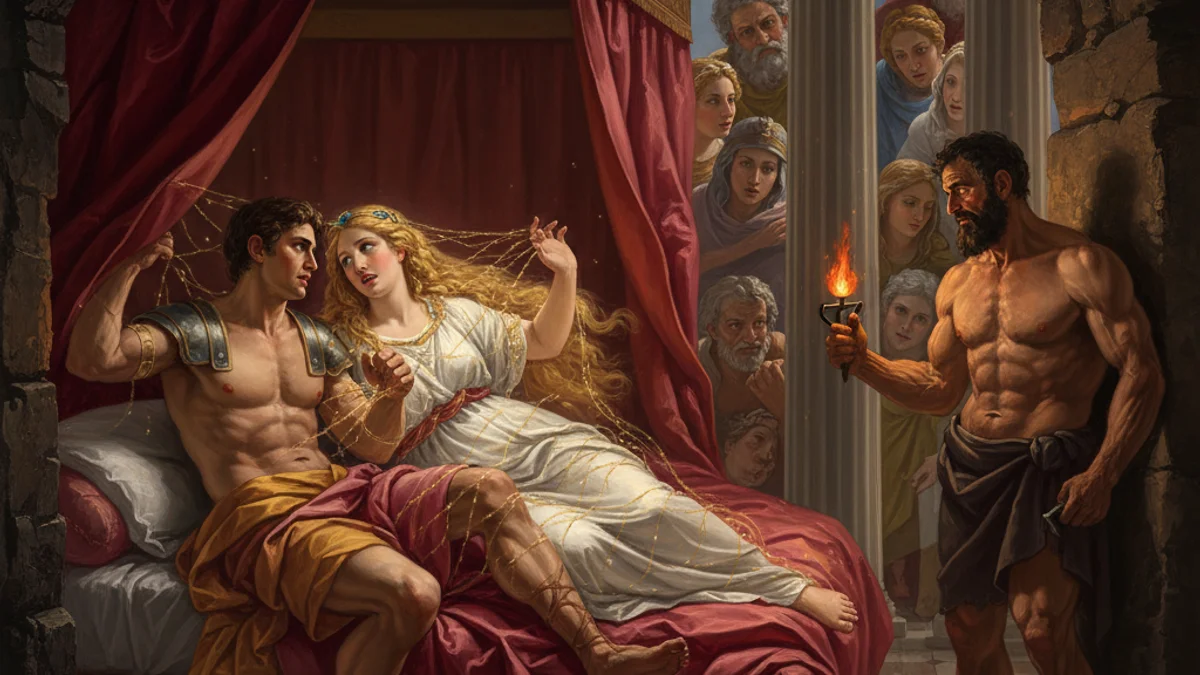
Hephaestus, the master smith of Olympus, was wed to the beautiful Aphrodite, but her heart belonged to the fierce god of war, Ares. Informed of their secret trysts by Helios the sun-god, Hephaestus did not resort to violence. Instead, he retreated to his forge and hammered out a net of bronze links so fine they were invisible to the eye, yet strong enough to hold a god. He draped the trap over his marriage bed and feigned a trip to Lemnos. As Ares and Aphrodite lay together, the snare fell, binding them in an inescapable, tangled embrace. Hephaestus returned and threw wide the doors, calling the other Olympians to witness the betrayal. While the goddesses stayed away out of modesty, the gods came and roared with laughter at the sight of the mighty warrior trapped by the clever smith. Only after Poseidon promised that Ares would pay the adulterer's fine did Hephaestus release the pair, who fled in deep humiliation.
Deceit and betrayal eventually lead to public shame, proving that wit and patience can outmatch even the most powerful strength.
Questions about this story
What is the moral of Hephaestus and Aphrodite's Net?
The story teaches that infidelity and dishonesty lead to public humiliation. It also highlights that intelligence and craftsmanship can triumph over raw physical power and beauty.
Who revealed the affair to Hephaestus?
The sun god, Helios, witnessed Ares and Aphrodite together from his chariot in the sky. He reported the betrayal to Hephaestus, prompting the smith god to devise his revenge.
What did the other gods do when they saw the net?
Most of the male gods laughed at the embarrassing situation, famously noting that 'the slow catches the swift.' However, Poseidon remained serious and negotiated for the release of the lovers.
What was Hephaestus's net made of?
Hephaestus forged the net out of bronze. It was described as being as thin as a spider's web and invisible to the naked eye, yet completely unbreakable by any god or mortal.
Advertisement

Good night.
