
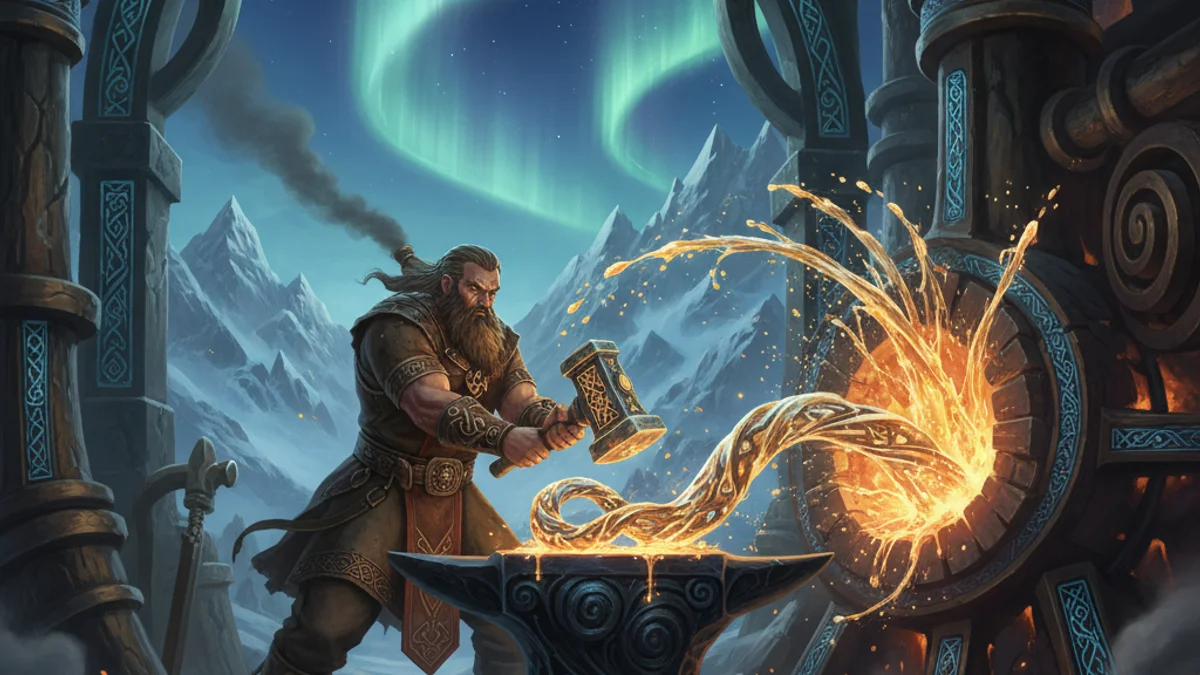
Väinämöinen, the wise singer, had promised the Mistress of the North, Louhi, that the eternal smith Ilmarinen would forge the Sampo—a magical mill of infinite prosperity—in exchange for her daughter's hand. When Ilmarinen refused to leave his homeland, Väinämöinen used magic to conjure a golden-topped fir tree and a whirlwind that swept the smith away to the dark realm of Pohjola. Upon arrival, Louhi welcomed him with a feast, demanding the artifact. Ilmarinen built a massive forge, using the winds as his bellows. For days, the forge birthed failures: a golden crossbow that demanded blood, a silver boat that started wars, and a copper cow that wasted milk. Finally, Ilmarinen focused his divine skill, and from the fire emerged the Sampo. It featured a many-colored lid and three mills: one for grain, one for salt, and one for gold. The North grew wealthy instantly, but Louhi locked the treasure deep within a copper mountain, leaving the smith to return home without his promised bride.
True mastery requires persistence through failure, but even the greatest gifts can become a source of greed and conflict if not shared.
Questions about this story
What is the Sampo in Finnish mythology?
The Sampo is a magical artifact or mill that grinds out infinite flour, salt, and gold, bringing eternal wealth to its possessor. It is the central treasure of the Kalevala epic.
Why did Ilmarinen forge the Sampo?
He forged it as a ransom or dowry for the daughter of Louhi, the Mistress of Pohjola, after being tricked into traveling to the North by Väinämöinen.
Who is Louhi in the Kalevala?
Louhi is the powerful and often antagonistic matriarch of Pohjola, a land of darkness and cold. She is a skilled sorceress who seeks the Sampo to ensure her people's prosperity.
What were the failed items Ilmarinen forged first?
Before the Sampo was perfected, the forge produced a beautiful but evil crossbow, a silver boat that sought unnecessary battle, and a copper cow that was difficult to manage.
Advertisement
Good night.
