
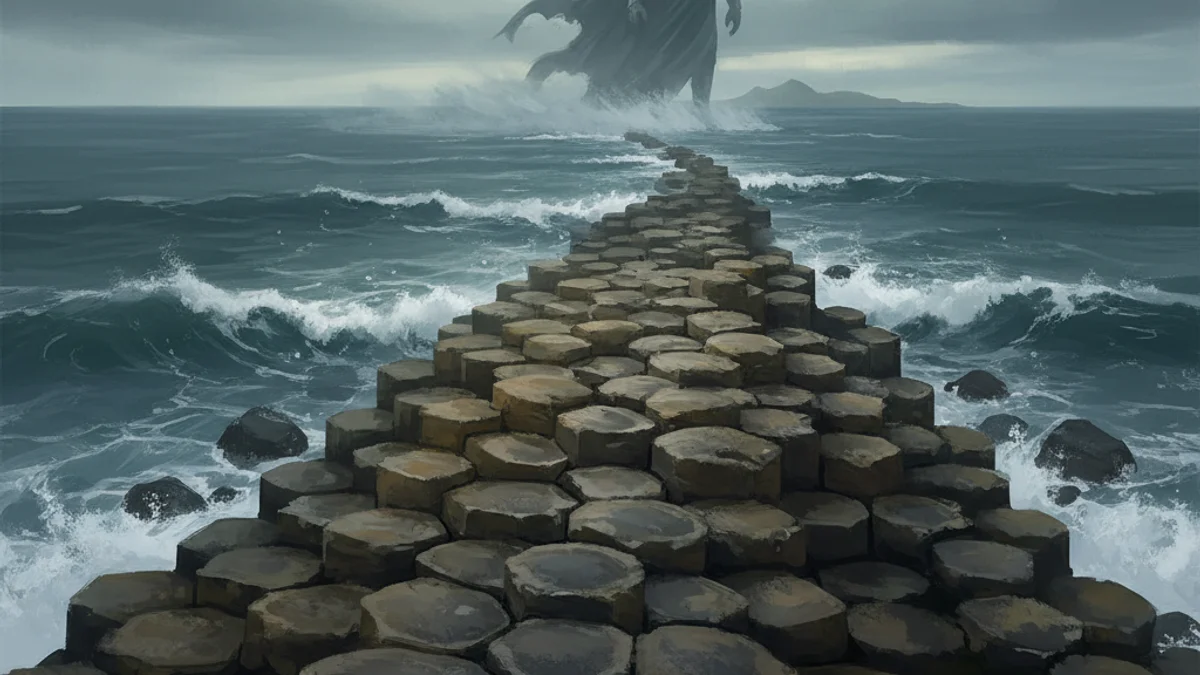
In the ancient days, the Scottish giant Fingal lived on the Isle of Staffa. Across the sea in Ireland lived his rival, the massive giant Benandonner. Tired of Benandonner’s constant taunts, Fingal built a great stone causeway across the North Channel so they could meet in battle. However, as Benandonner approached, Fingal realized his foe was far larger and more terrifying than he had imagined. Retreating to his home, Fingal sought the help of his clever wife, Oonagh. She dressed Fingal as a massive infant and tucked him into a giant cradle. When Benandonner arrived, Oonagh told him Fingal was away but invited him to see their 'baby.' Upon seeing the enormous size of the infant, Benandonner was struck with terror. He reasoned that if the child was this large, the father must be a titan beyond comprehension. Benandonner fled back to Ireland in a panic, tearing up the causeway behind him to ensure the monstrous Fingal could never follow.
Wit and quick thinking are more powerful than brute force when facing a seemingly insurmountable challenge.
Questions about this story
What is the moral of Fingal and the Giant's Causeway?
The moral is that intelligence and ingenuity can defeat even the strongest of enemies. Fingal and Oonagh win not through combat, but through a clever psychological trick.
Who are the two giants in the story?
The story features Fingal (the Scottish version of the Irish hero Fionn mac Cumhaill) and his rival Benandonner, often called the Red Man.
Is the Giant's Causeway a real place?
Yes, it is a UNESCO World Heritage site in Northern Ireland consisting of 40,000 interlocking basalt columns formed by ancient volcanic activity.
How did Oonagh trick Benandonner?
Oonagh disguised her husband as a baby. When Benandonner saw the size of the 'infant,' he became terrified of how large the father must be.
Advertisement

Good night.
