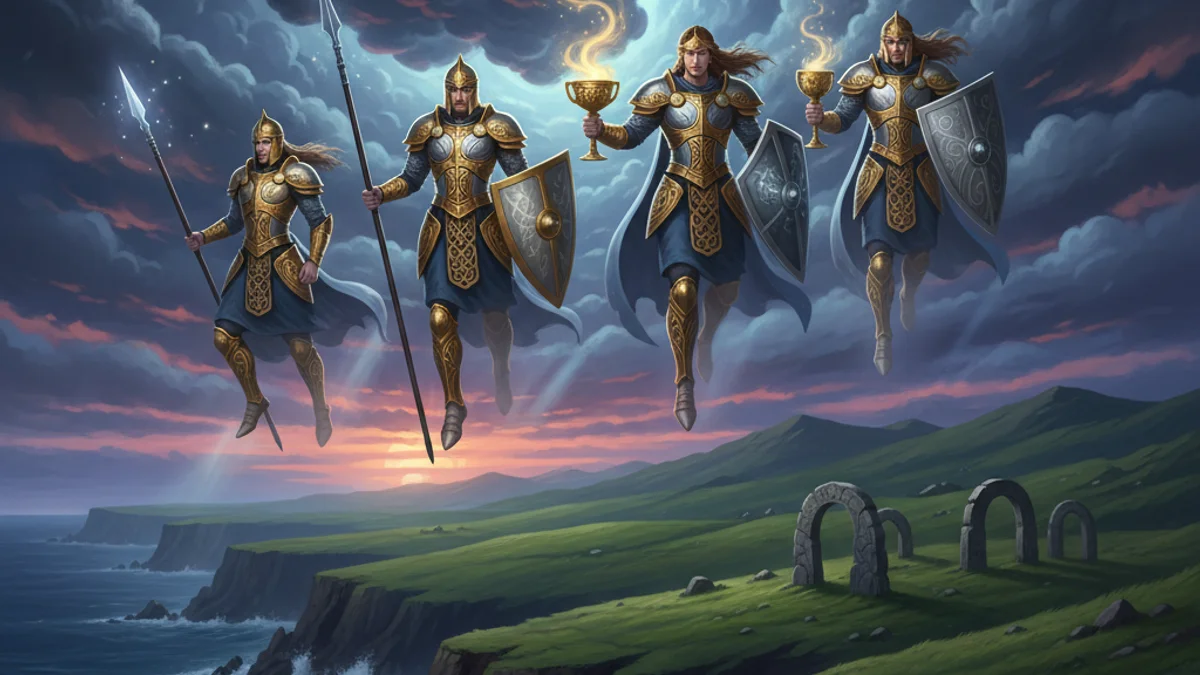
The Book of Invasions, or Lebor Gabála Érenn, chronicles the legendary history of Ireland through six successive waves of settlers. It begins with Cessair, granddaughter of Noah, who arrived before the Great Flood. After the waters receded, the land was claimed by Partholón, who introduced agriculture, and then Nemed, whose people fought the monstrous sea-raiders known as the Fomorians. Following them were the Fir Bolg, who divided Ireland into its five provinces. The most mystical wave was the Tuatha Dé Danann, a race of god-like beings who arrived in dark clouds, bringing four magical treasures. They defeated the Fir Bolg and the Fomorians in epic battles, establishing a golden age of magic and craft. However, their reign ended with the arrival of the Milesians, the ancestors of the modern Irish. Through a mix of steel and sorcery, the Milesians conquered the surface world, forcing the Tuatha Dé Danann to retreat into the hollow hills and mounds, where they became the legendary Aes Sidhe, or fairy folk of Ireland.
National identity is a layered tapestry woven from many cultures, teaching that we are all products of those who came before us.
Advertisement
Questions about this story
What is the moral of The Book of Invasions?
The story suggests that identity is formed through the integration of different cultures and histories. It emphasizes that every group contributes something lasting to the land, even if their time of dominance eventually ends.
Who were the Tuatha Dé Danann?
They were a race of supernatural beings with immense power in magic, art, and science. In mythology, they are the precursors to the fairies, having retreated into the earth after their defeat.
Is The Book of Invasions a true historical account?
It is a pseudo-historical collection of myths compiled by medieval monks. While it reflects ancient migration patterns, it blends pre-Christian folklore with biblical narratives to create a national epic.
How many invasions are recorded in the book?
The text traditionally describes six distinct waves of settlers, each facing unique challenges. These include the followers of Cessair, Partholón, Nemed, the Fir Bolg, the Tuatha Dé Danann, and finally the Milesians.
Advertisement