
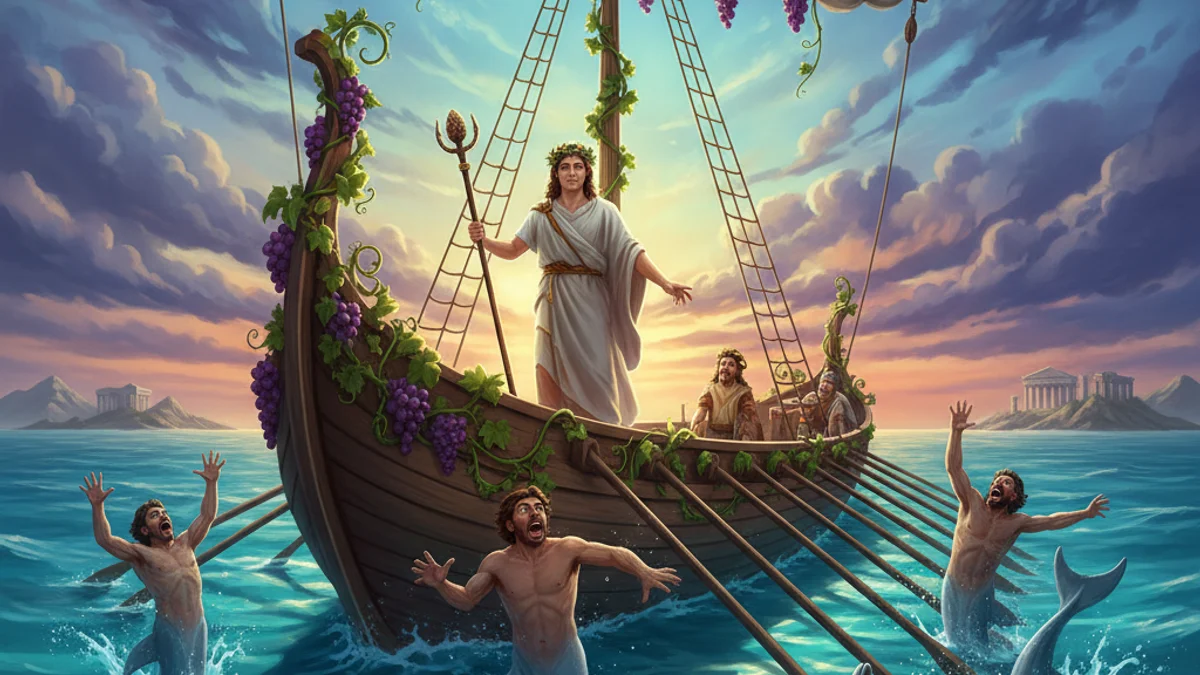
Dionysus, the god of wine and revelry, once stood upon a lonely shore in the guise of a handsome, dark-haired youth. A passing ship of Tyrrhenian pirates spotted him and, believing he was the son of a wealthy king, kidnapped him to sell for ransom. Only the helmsman, Acoetes, sensed a divine presence and pleaded with his crew to release the boy, but they mocked him and set sail. Suddenly, the ship ground to a halt as if rooted in the earth. Fragrant wine began to flow across the deck, and thick ivy climbed the mast, bearing heavy clusters of grapes. Terrified, the pirates watched as Dionysus transformed into a roaring lion, while a phantom bear appeared beside him. The sailors, driven mad with fear, leapt into the sea. As they hit the water, Dionysus transformed them into dolphins, sparing only the pious helmsman to whom he revealed his true identity as a powerful Olympian.
True power and divinity often hide beneath a humble exterior, and those who fail to show respect or recognize the sacred do so at their own peril.
Questions about this story
What is the moral of Dionysus and the Pirates?
The moral is to respect the divine and look beyond outward appearances. It serves as a warning against greed and the hubris of thinking one can control or exploit nature and the gods.
Why did Dionysus turn the pirates into dolphins?
He transformed them as a punishment for their greed and lack of piety. While they lost their human forms, the transformation into dolphins was also seen as an act of mercy compared to death, allowing them to live on in the sea.
Who was Acoetes in the story of Dionysus?
Acoetes was the ship's helmsman and the only crew member who recognized Dionysus's divine nature. Because he tried to stop the kidnapping and showed the god respect, Dionysus spared him and took him into his service.
What miracles did Dionysus perform on the pirate ship?
Dionysus caused wine to flow through the ship, grew vines and ivy over the mast, and manifested as a lion. These displays of power were meant to terrify the captors and prove his status as a god.
Advertisement

Good night.
