
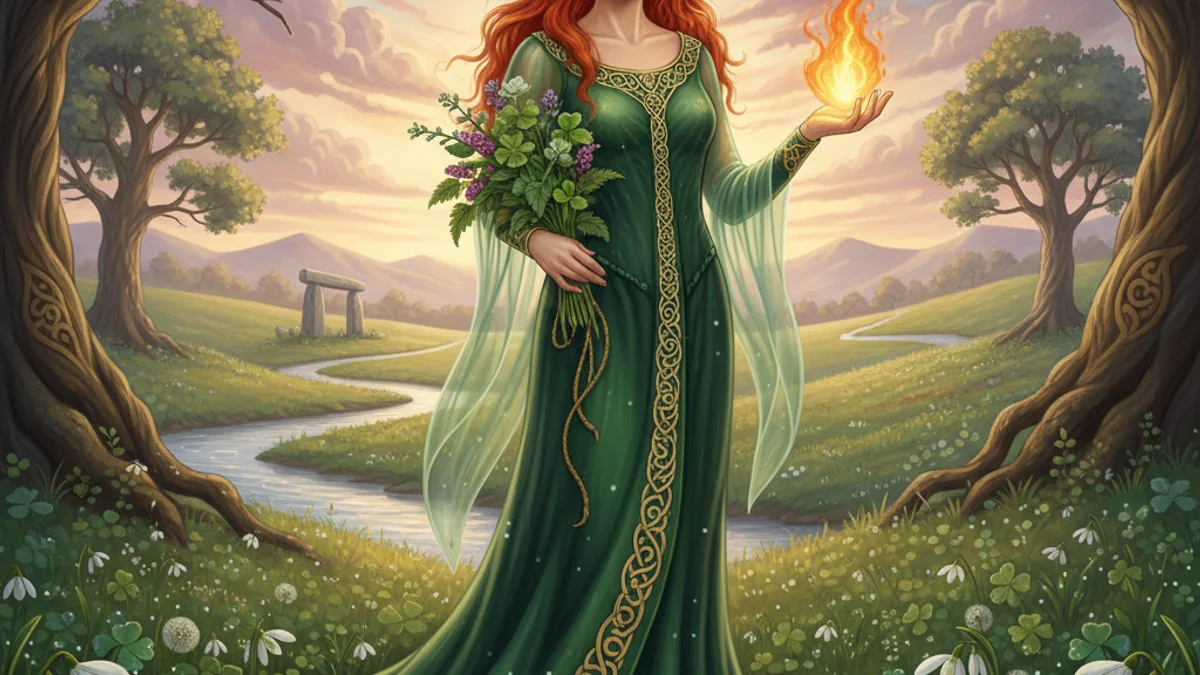
In the ancient days of the Tuatha Dé Danann, Brigid was born as the daughter of the Dagda, the Great God of Ireland. While her brothers practiced the arts of war, Brigid turned her gaze toward the arts of life. She became the mistress of the triple flame: the flame of inspiration for poets, the flame of the forge for smiths, and the most sacred flame of all—the flame of healing. Legend tells of a time when a great plague swept through the green hills, leaving even the bravest warriors weak and the land itself withered. Brigid traveled across the emerald plains, her presence preceded by the scent of spring flowers even in the heart of winter. She did not use weapons to drive back the darkness; instead, she used the water from sacred wells and her deep knowledge of herbs. With a touch of her hand, she mended broken limbs and soothed fevered brows. She taught the people that healing was not just of the body, but of the spirit, showing them how to find harmony with the earth. As she walked, it is said that the first snowdrops began to bloom in her footprints, signaling that life would always return to those who nurtured it.
True power lies in the ability to restore and nurture life rather than destroy it.
Questions about this story
Who is Brigid in Irish mythology?
Brigid is a member of the Tuatha Dé Danann and the daughter of the Dagda. She is the goddess of healing, poetry, smithing, and the arrival of spring.
What is the moral of Brigid the Healer?
The story emphasizes that compassion and the preservation of life are the highest forms of wisdom. It teaches that restoration is a more enduring power than destruction.
What are the three flames of Brigid?
Brigid is associated with the triple flame representing different types of fire: the fire of the hearth (healing), the fire of the forge (craft), and the fire of the sun (poetry and inspiration).
How is Brigid connected to the festival of Imbolc?
Imbolc is the ancient Gaelic festival marking the beginning of spring, celebrated on February 1st. It is dedicated to Brigid and honors the return of light and fertility to the land.
Advertisement

Good night.
