Story Summary
Experience the wit of Nasrudin and the Elephant, a Sufi tale where the Mulla's cleverness turns his neighbors' cowardice into a hilarious lesson on solidarity.
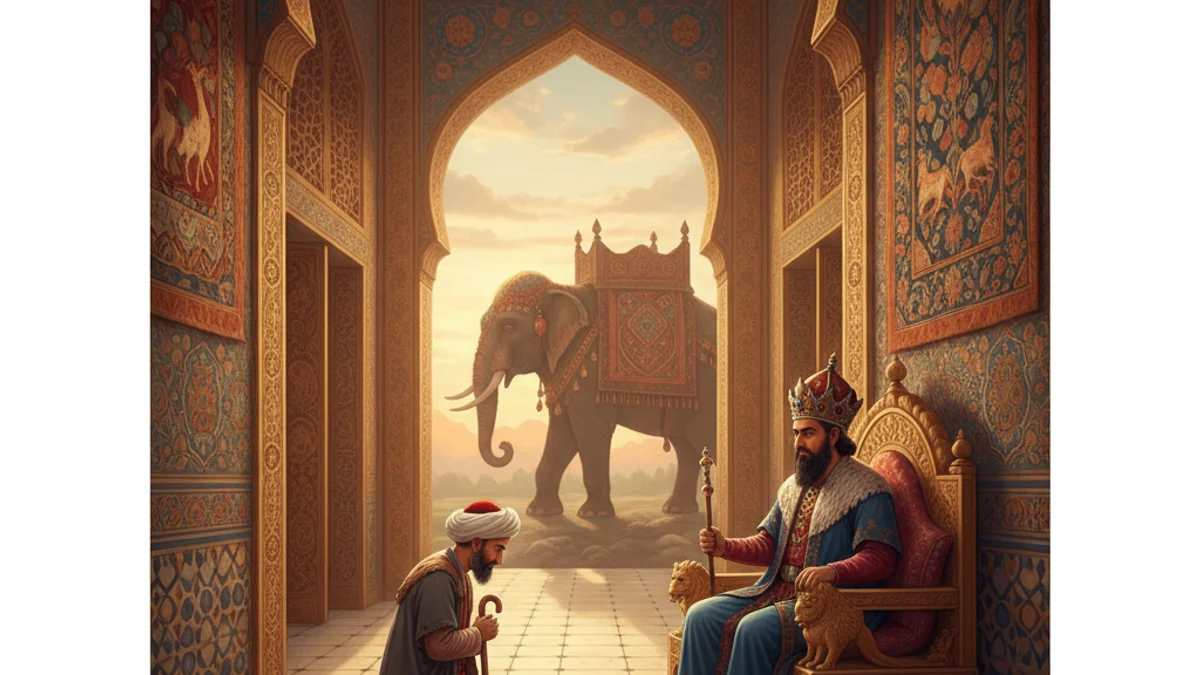
The Great Conqueror Tamerlane arrived in Mulla Nasrudin’s village with a massive war elephant. While technically a royal gift, the beast was a nightmare for the town, devouring entire harvests and crushing property under its weight. Desperate, the villagers begged Nasrudin to lead a delegation to the King to request its removal. Nasrudin agreed, but only on the condition that the townsfolk stood directly behind him to show their collective resolve. As the group approached the royal throne room, the villagers grew increasingly terrified of the King’s temper and slipped away one by one. When Nasrudin finally reached the King and looked back, he realized he was standing entirely alone. 'What is the meaning of this visit, Mulla?' the King barked. Sensing his life was at risk if he complained alone, Nasrudin bowed and said, 'Your Majesty, your elephant is so beloved by our village that we noticed it seems quite lonely. We have come to request a second elephant to keep it company!'
The Moral
If you abandon your leader in a moment of crisis, you must be prepared to live with even heavier consequences of your cowardice.
“Your Majesty, our elephant is lonely; we wish for another to keep it company!”
Fun Fact
Mulla Nasrudin is a beloved figure across many cultures and is known by different names, such as Goha in Egypt or Afanti in China.
Frequently Asked Questions
What is the moral of Nasrudin and the Elephant?
The moral is that collective action requires true commitment. If you abandon those who speak for you out of fear, you may end up doubling the burden you were trying to escape.
Who is Mulla Nasrudin in Sufi tradition?
Nasrudin is a wise-fool character used in Sufi teaching stories to illustrate spiritual and social truths. His tales often use humor to bypass the ego and deliver deep psychological insights.
Why did Nasrudin ask for a second elephant?
He asked for a second elephant because the villagers who promised to support him fled in fear. To save himself from the King's wrath, he used irony to punish the villagers for their cowardice.
What does the elephant represent in this story?
The elephant represents a heavy social or political burden imposed by a ruler. It also symbolizes the 'elephant in the room' that people are too afraid to address directly.
Is this the same as 'The Blind Men and the Elephant'?
No, that is a different parable about perspective and partial truth. This Nasrudin tale focuses on social responsibility, leadership, and the consequences of fear.
What is the historical context of the King in this story?
The King is often identified as Tamerlane (Timur), the Turco-Mongol conqueror. Many Nasrudin stories feature him as a foil to the Mulla's common-man wisdom.
Discussion (0)
Share your thoughts on this story
No comments yet. Be the first to share your thoughts!