Story Summary
Discover the legend of The Hydra of Lerna as Hercules faces a multi-headed beast that regrows limbs. A classic Greek myth about bravery and clever strategy.
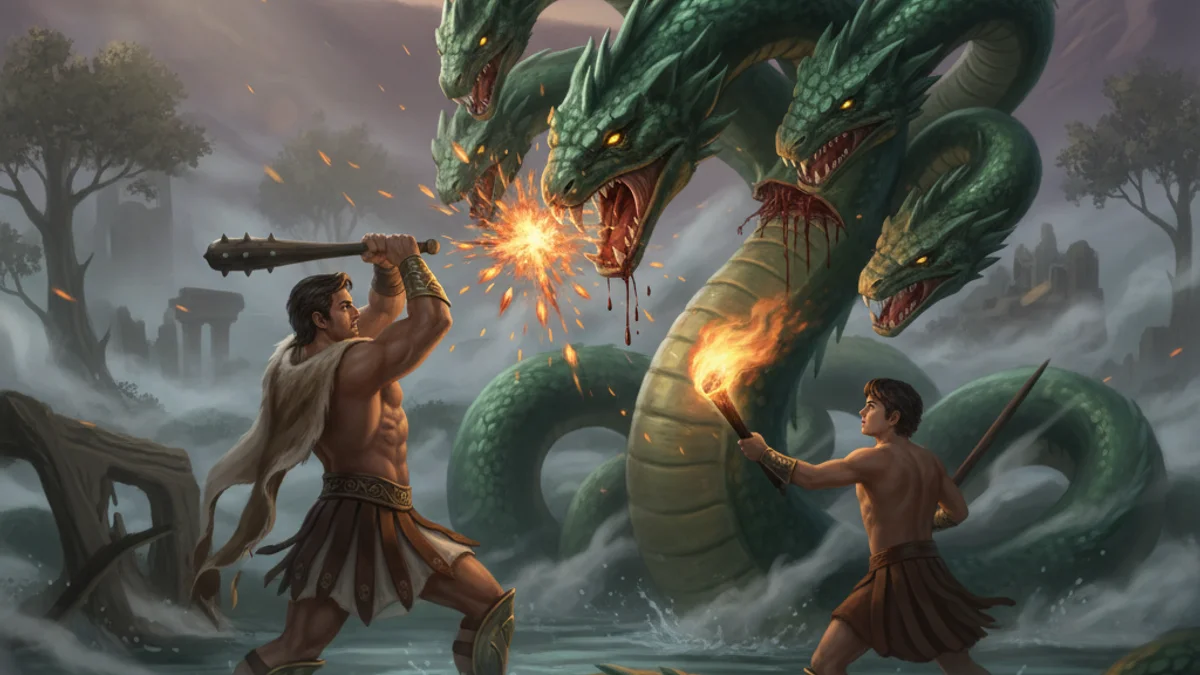
As his second labor, the hero Hercules was sent to the dark swamps of Lerna to destroy the Hydra, a monstrous serpent with nine heads. The beast was a terror to the countryside, and its breath alone was lethal. When Hercules confronted the creature, he began lopping off its heads with his sword, but to his horror, for every head he severed, two more grew back in its place. Realizing that brute force alone would not prevail, Hercules called upon his nephew, Iolaus. As Hercules cut each head away, Iolaus used a flaming torch to cauterize the raw stumps, preventing the heads from regenerating. Finally, only the middle head remained—the one that was immortal. Hercules sliced it off, buried it deep beneath a massive boulder by the roadside, and dipped his arrows in the creature's venomous blood, marking his victory over the regenerating nightmare.
The Moral
Some problems cannot be solved by strength alone; they require strategy, persistence, and sometimes the help of others.
“For every head that falls, two more shall rise in its place.”
Fun Fact
The Hydra's blood was so toxic that even the scent was said to be fatal, and in astronomy, the largest constellation in the sky is named after this mythical beast.
Frequently Asked Questions
What is the moral of The Hydra of Lerna?
The story teaches that persistence and innovative strategy are necessary to overcome recurring obstacles. It also highlights that even the greatest heroes sometimes need help from others to succeed.
How many heads did the Hydra have?
While accounts vary among ancient poets, the Hydra is most commonly described as having nine heads, with the central one being immortal. Some legends suggest it had as many as fifty or even a hundred heads.
Who helped Hercules defeat the Hydra?
Hercules was assisted by his nephew Iolaus, who played a crucial role by cauterizing the Hydra's necks with fire. This prevented the monster from regenerating its heads, allowing Hercules to eventually reach the immortal one.
Why did King Eurystheus discount this labor?
The king refused to count the Hydra as one of the ten labors because Hercules had received assistance from Iolaus. As a result, Hercules was forced to perform two additional labors, bringing the total to twelve.
What happened to the Hydra's immortal head?
After severing the final, immortal head, Hercules buried it deep underground near the road to Elaeus. He placed a massive, heavy rock over the spot to ensure the head would remain trapped forever.
How did Hercules use the Hydra after its death?
Hercules dipped his arrows into the Hydra's poisonous blood, making them incredibly lethal. These venomous arrows became a powerful weapon in his future adventures, though they also played a role in his eventual death.
Discussion (0)
Share your thoughts on this story
No comments yet. Be the first to share your thoughts!