Story Summary
Discover the Greek myth of Hermes and Argus, where the messenger god uses music and wit to outsmart a hundred-eyed giant and free the captive nymph Io.
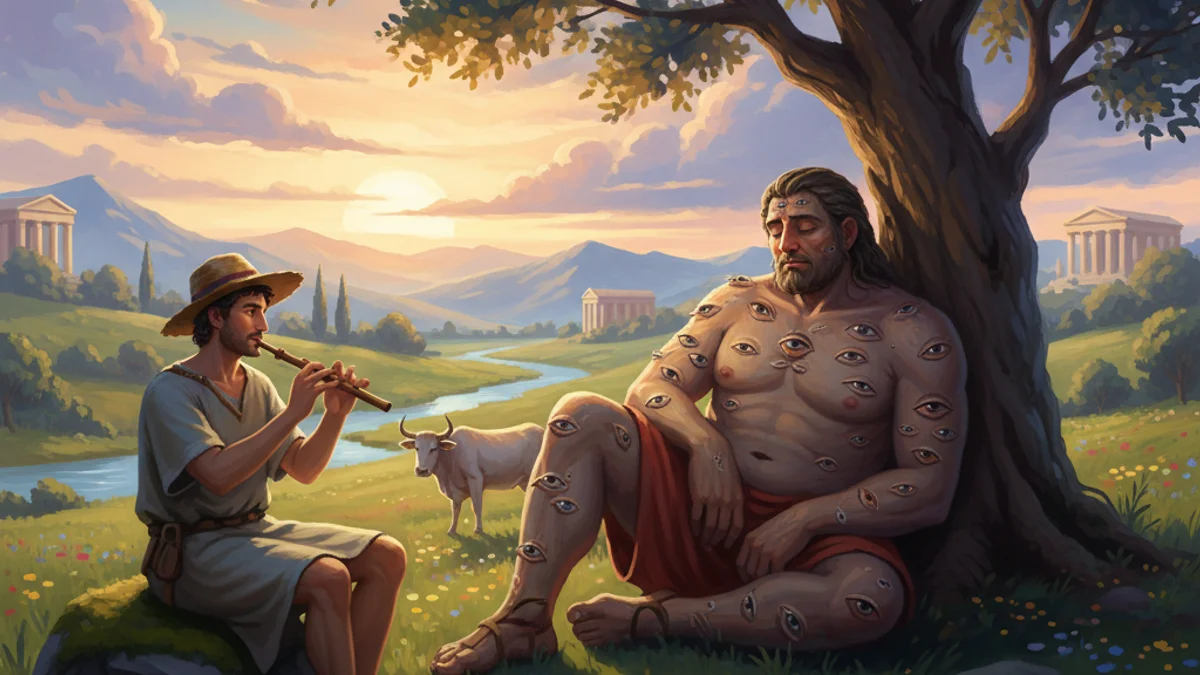
When Zeus fell in love with the nymph Io, his jealous wife Hera transformed the maiden into a white heifer to keep them apart. To ensure Io remained a prisoner, Hera appointed Argus Panoptes, a giant with a hundred eyes, to guard her. Because Argus only closed a few eyes at a time while sleeping, he was the perfect, ever-watchful sentry. Distressed by Io’s suffering, Zeus sent Hermes, the messenger god, to rescue her. Disguised as a shepherd, Hermes sat beside Argus and played a set of reed pipes, telling long, monotonous stories. One by one, the giant's eyes grew heavy until, finally, all one hundred closed in a deep slumber. Seizing the moment, Hermes struck down the giant and freed Io. To honor her fallen servant, Hera took Argus’s eyes and placed them upon the feathers of her favorite bird, the peacock.
The Moral
Cunning and wit can overcome even the most formidable and watchful defenses.
“Not even a hundred eyes can see through the veil of a masterfully woven song.”
Fun Fact
The term 'argus-eyed' is still used in the English language today to describe someone who is exceptionally vigilant or keen-sighted.
Frequently Asked Questions
What is the moral of Hermes and Argus?
The story teaches that intelligence and strategy are often more effective than brute force. It also suggests that even the most vigilant person has a weakness that can be exploited by a clever opponent.
Why did Hera have Argus guard Io?
Hera transformed Io into a cow out of jealousy and used Argus as a guardian because his hundred eyes meant he never truly slept. He was considered the ultimate watchman who could see everything at once.
How did Hermes lull Argus to sleep?
Hermes disguised himself as a shepherd and used the soothing music of his reed pipes combined with long, boring stories. Eventually, the monotony caused all one hundred of Argus's eyes to close simultaneously.
What happened to Argus's eyes after his death?
According to the myth, Hera was so saddened by the death of her loyal servant that she took his hundred eyes and placed them on the tail of the peacock. This explains the 'eye' patterns found on peacock feathers today.
Who was Io in this Greek myth?
Io was a mortal priestess of Hera whom Zeus fell in love with. To hide her from Hera's wrath, she was turned into a white heifer, leading to her imprisonment under the watch of Argus.
Why is Argus called 'Panoptes'?
The epithet 'Panoptes' means 'all-seeing' in Greek. It refers to his unique physical trait of having one hundred eyes, which allowed him to keep watch in all directions at all times.
Discussion (0)
Share your thoughts on this story
No comments yet. Be the first to share your thoughts!